
Holiday Jewelry Sales Training: A Product Comparison Playbook
Give jewelry retail teams a repeatable holiday sales-training routine for discovery questions, product comparisons, accurate moissanite claims and faster gift decisions.
Holiday jewelry sales training should help an associate do three things quickly: understand the shopper’s purchase mission, compare two relevant options and describe the product accurately. A useful routine is short enough to repeat before every shift and specific enough to keep the conversation from becoming a feature dump.
Quick answer: Build a three-product training tray, give each product one purchase mission, teach four discovery questions, practice a two-option comparison and require associates to verify material, dimensions, closure and care information from the product record. Finish with one clear next step: try on, gift packaging, availability check or wholesale reorder.
Why holiday sales training matters in 2026
The National Retail Federation reported that 56% of 2026 holiday shoppers say the economy will affect their spending plans. Among that group, 43% plan to shop sales more often and 31% plan to comparison-shop online more often. NRF also found that 43% of holiday shoppers expect to start before November, while 64% say they are likely to wait until Thanksgiving weekend to do most of their shopping.
For jewelry retailers, that creates two simultaneous customer behaviors: early browsers collecting information and deal-period shoppers trying to decide quickly. Associates need a comparison method that communicates value without inventing urgency, overstating product differences or relying only on a discount.
Build a three-product training tray
Start with three products that serve different purchase missions. The objective is not to memorize the entire assortment. It is to teach a repeatable comparison pattern that can be transferred to other products.
- Easy-to-gift core: a familiar silhouette with a simple wearing story, such as halo stud earrings.
- Fashion-forward alternative: a style with visible movement or profile, such as pave hoop earrings.
- Complete gift moment: a necklace that creates a focal point and can be presented in a gift box.

LEKANI’s current Round Moissanite Halo Stud Earrings in S925 Sterling Silver, Pave Moissanite Hoop Earrings in S925 Sterling Silver and Three-Stone Bezel Moissanite Necklace in S925 Sterling Silver provide a practical example. All three are rhodium-plated S925 silver-tone moissanite styles, but their silhouettes, viewing angles and gifting roles are different.
Teach four discovery questions before product facts
A good associate does not begin with a long product description. Begin with questions that reduce the choice set:
- Who is the gift for? A partner, family member, friend, bridal customer or self-purchaser may have a different comfort level with statement scale.
- What does the recipient wear most often? Ask whether they regularly wear studs, hoops, necklaces or a mix.
- Is the goal everyday wear or a stronger holiday moment? This separates a core style from a more noticeable silhouette without labeling one as universally “better.”
- What timing matters? Confirm whether the shopper needs the item today, needs it shipped or is comparing options for a later visit.
These questions create a reason for the comparison. They also keep an associate from assuming a recipient’s age, taste or budget based on appearance.
Use a fact–difference–fit comparison
For each product, train the associate to deliver three short statements:
- Fact: one verified material, construction or size detail.
- Difference: the visible way this option differs from the other choice.
- Fit: the purchase mission or wearing preference it may suit.
Example: halo studs
Fact: The current style is rhodium-plated S925 sterling silver, sold as a pair, with 6.5 mm and 10 mm center-stone options. Difference: The halo creates a round, front-facing look, while the two size options change the visual scale. Fit: It can suit a shopper who wants a familiar stud silhouette with a stronger framed appearance.
Important training detail: the product record notes that the stated size refers to each center stone, not the overall earring diameter, and the shared design images do not show the two sizes to scale. Associates should verify the selected option instead of pointing to an image and guessing.
Example: pave hoops
Fact: The current hoops are rhodium-plated S925 sterling silver with a hinged closure and rows of small moissanite stones along the curved front. Difference: Hoops show a side profile and movement that a front-facing stud does not. Fit: They can suit a shopper who knows the recipient regularly wears hoops or wants a more fashion-led earring gift.
Example: three-stone necklace
Fact: The current necklace uses three graduated round moissanite stones in smooth bezel settings along a delicate chain. Difference: It creates a horizontal focal detail at the neckline rather than framing the face. Fit: It can suit a shopper who wants one complete gift presentation or prefers necklaces over earrings.
Role-play the two-option conversation
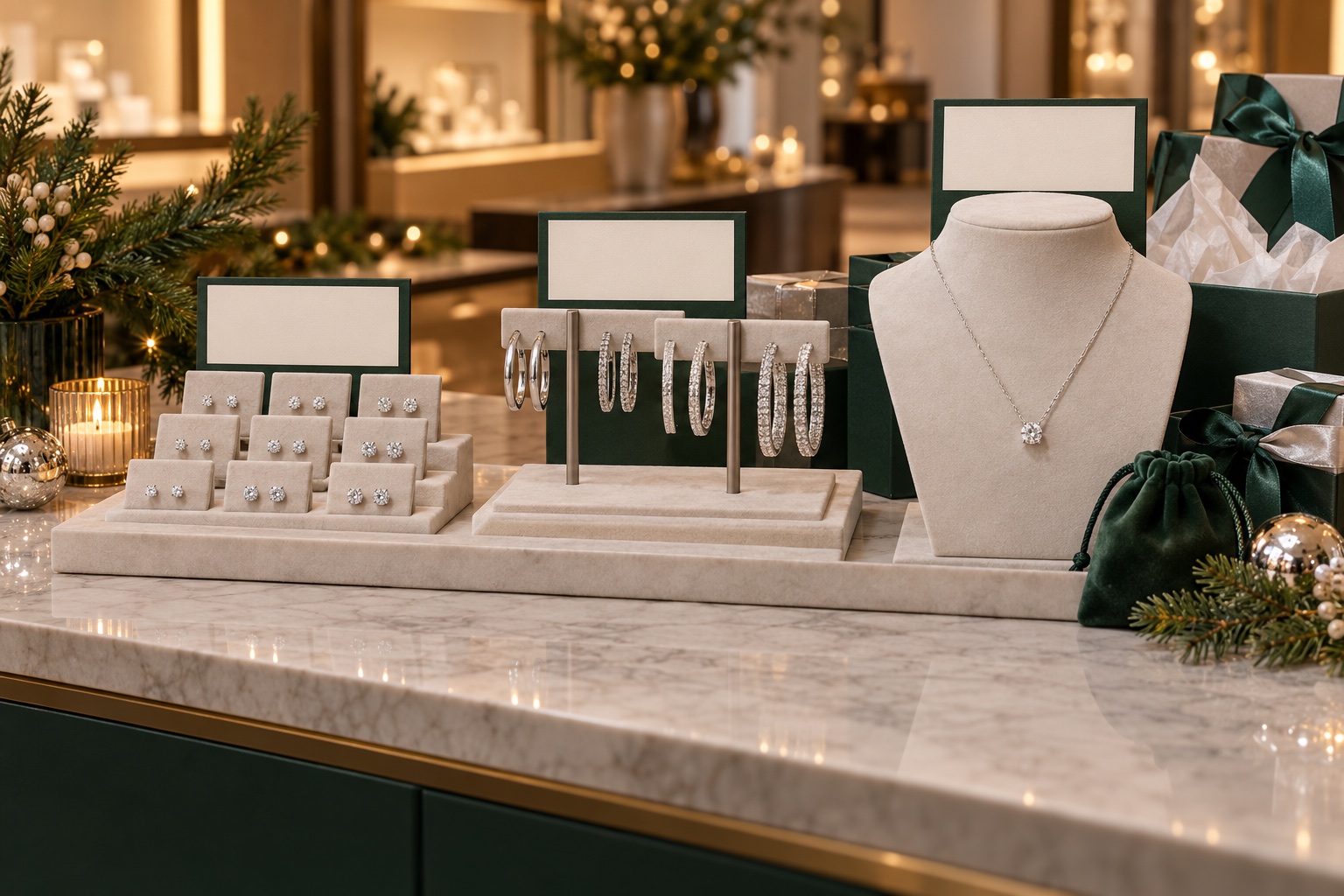
Associates rarely need to present every item in a case. Practice moving from a discovery answer to two relevant options:
“You mentioned she wears small earrings most days but likes a little more sparkle for events. These halo studs keep a front-facing stud shape, while these pave hoops add profile and movement. Would you like to compare them on scale, closure or how they would be packaged?”
The script works because it identifies a difference, connects it to the shopper’s answer and offers a next comparison. It does not claim that one style is higher quality, more durable or more valuable without evidence.
Keep moissanite claims accurate
The Federal Trade Commission says jewelry product claims must be accurate and that sellers should truthfully describe the type, quality, metallic content, size, weight, treatment and other material characteristics of an item. The FTC also warns that some thermal testers used to distinguish diamond from cubic zirconia may not correctly identify moissanite.
Use the product record as the source of truth. Train associates to avoid improvising claims about diamond equivalence, grading, treatments, origin, certification, lifetime performance or resale value unless the business has documentation that supports the statement. Describe moissanite as moissanite; do not let a tester result replace proper identification.
A five-point product knowledge card
- Product name and verified material
- Finish and visible metal tone
- Stone type and documented dimensions
- Closure, fit or wearing orientation
- Care guidance and current availability source
If a detail is missing, the associate should say they will verify it. A short accurate answer builds more trust than a confident guess.
Create a fast holiday decision station
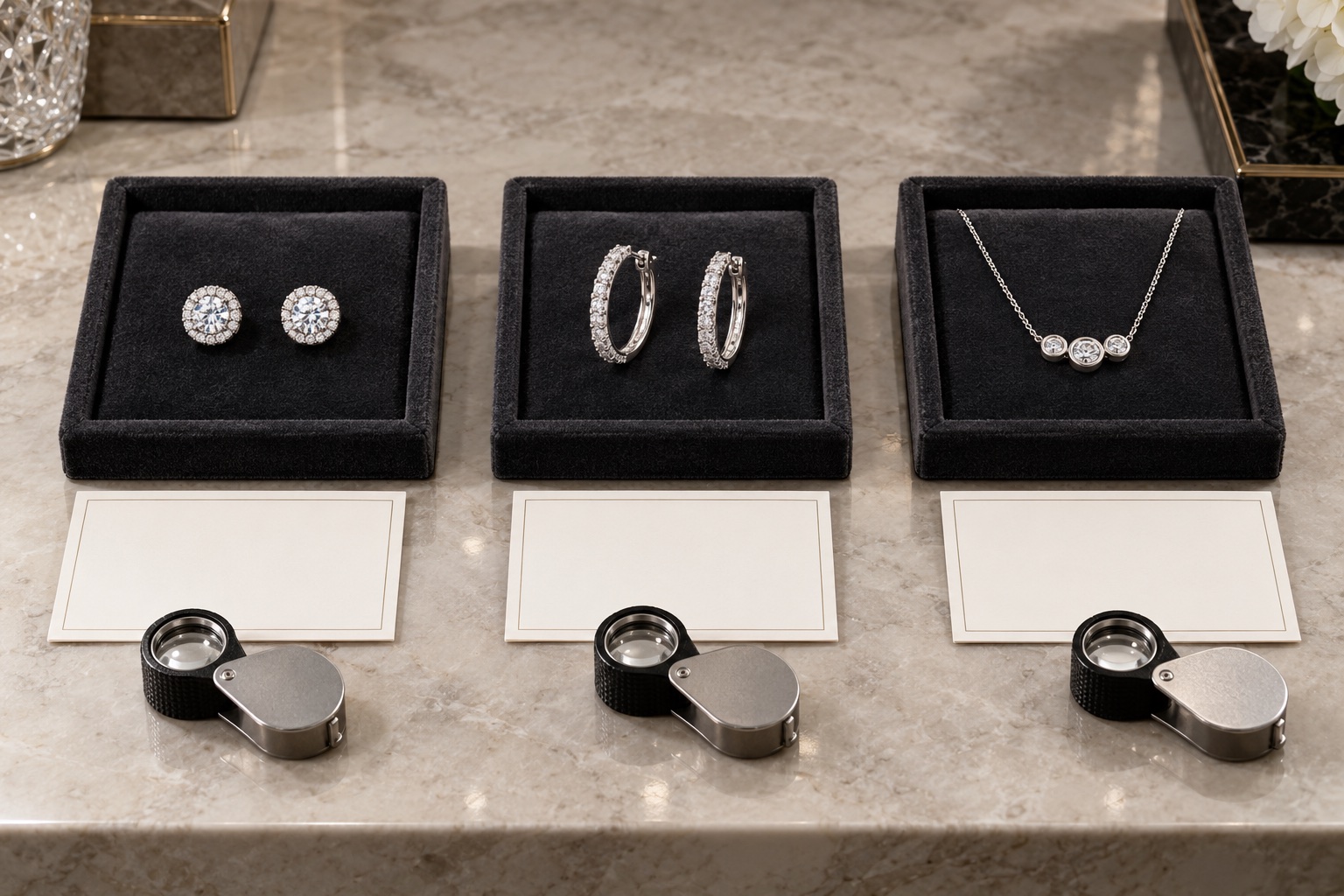
After training, apply the same structure to a compact decision station. Group products by purchase mission rather than placing every style in one undifferentiated row. Keep packaging, care information and the next fulfillment step close enough that the associate can complete the conversation without leaving the shopper.
A station might include an easy-to-gift stud, a fashion hoop and a necklace, with one approved product card for each. Online retailers can mirror the same pattern with comparison copy, scale information, closure photos, gift-ready imagery and internal links between the three options.
Timing should also be part of training. USPS lists December 17, 2026 as the recommended send-by date for Ground Advantage and First-Class Mail in the contiguous United States for expected delivery before December 25, with later dates for Priority Mail and Priority Mail Express. USPS also notes that actual delivery can vary. Retailers should set their own order-by dates with an operational buffer and never promise arrival solely from a carrier’s final recommended date.
A 15-minute pre-shift training routine
- Three minutes: verify the three selected products, options and availability.
- Three minutes: each associate gives one fact–difference–fit comparison.
- Four minutes: role-play one early browser and one time-sensitive gift shopper.
- Three minutes: check one claim that must not be improvised.
- Two minutes: confirm packaging, pickup, shipping and escalation steps.
Rotate the training tray weekly so the team practices the method across studs, hoops, necklaces, rings, bracelets and chains. Track which customer questions cause hesitation; those questions should determine the next product knowledge card.
Frequently asked questions
What should jewelry sales training include before the holidays?
Include verified product facts, discovery questions, two-option comparisons, accurate claim boundaries, packaging and fulfillment steps, and short role-play. The goal is consistent decision support, not memorizing a long script.
How do you train associates to compare jewelry without focusing only on price?
Use visible and verifiable differences such as silhouette, scale, orientation, closure and wearing preference. Connect those differences to the shopper’s stated need, then discuss price and promotions accurately when relevant.
What are safe moissanite selling points?
Start with the verified stone identity, setting, size, metal and design. Associates may describe what they can demonstrate visually, but they should not improvise diamond-equivalence, certification, treatment or durability claims that are not supported by product documentation.
How many products should be used in a training exercise?
Three products are enough for a focused pre-shift routine: one core option, one alternative and one different product type. During a customer conversation, narrow the presentation to two relevant choices whenever possible.
How often should a holiday training tray change?
Review it at least weekly and whenever inventory, promotions, shipping dates or priority products change. Do not continue training on an unavailable item unless it is clearly being used only as a method example.
Prepare the next holiday counter conversation
Choose three current products, build one verified knowledge card for each and run the 15-minute routine before the next peak shift. Then use the questions your team cannot answer as the brief for the following training session.
Shop Moissanite Earrings | Shop Moissanite Necklaces | Apply for a Wholesale Account
Availability note: The referenced products were published and available when reviewed on October 22, 2026. Confirm current product details, inventory and wholesale terms before planning a promotion or training session.
Sources: National Retail Federation 2026 holiday survey; Federal Trade Commission Jewelry Guides business guidance; USPS 2026 holiday shipping deadlines.


