
Jewelry Product Listing Checklist for Holiday 2026: A Retailer’s Guide
A practical B2B checklist for U.S. jewelry retailers preparing holiday product pages. Organize verified materials, sizing, imagery, FAQs and internal links so shoppers—and AI tools—can understand each item.
Holiday shoppers increasingly compare products before they commit, and many now use AI tools to narrow their choices. For jewelry retailers, that makes a complete, consistent product page more than a merchandising detail: it is part of search visibility, customer confidence, and conversion readiness. A recent JCK summary of McKinsey’s 2026 holiday forecast reported that 46% of surveyed consumers expected to use AI tools for holiday shopping, especially for product and price comparisons, deals, and gift ideas.
This jewelry product listing checklist helps U.S. retailers turn verified supplier information into useful holiday product pages. It is written for moissanite and S925 sterling silver jewelry, but the same workflow also applies to tennis jewelry, silver chains, and solid-gold chains. Use it before you publish a new item, import supplier data, or refresh a seasonal collection.
Quick answer: What should every jewelry product listing include?
At minimum, a retail jewelry listing should identify the product type, stone, base metal, finish or plating, dimensions, size or length options, closure or setting, what is included, care guidance, shipping or availability information, and a clear purchase action. Images should show the full item, scale, construction details, and any relevant finish or color differences. Every claim should match the actual SKU.
Retailer rule: If a field can change by variant, keep it at the variant level. Do not describe every option as if it has the same size, finish, weight, or configuration.
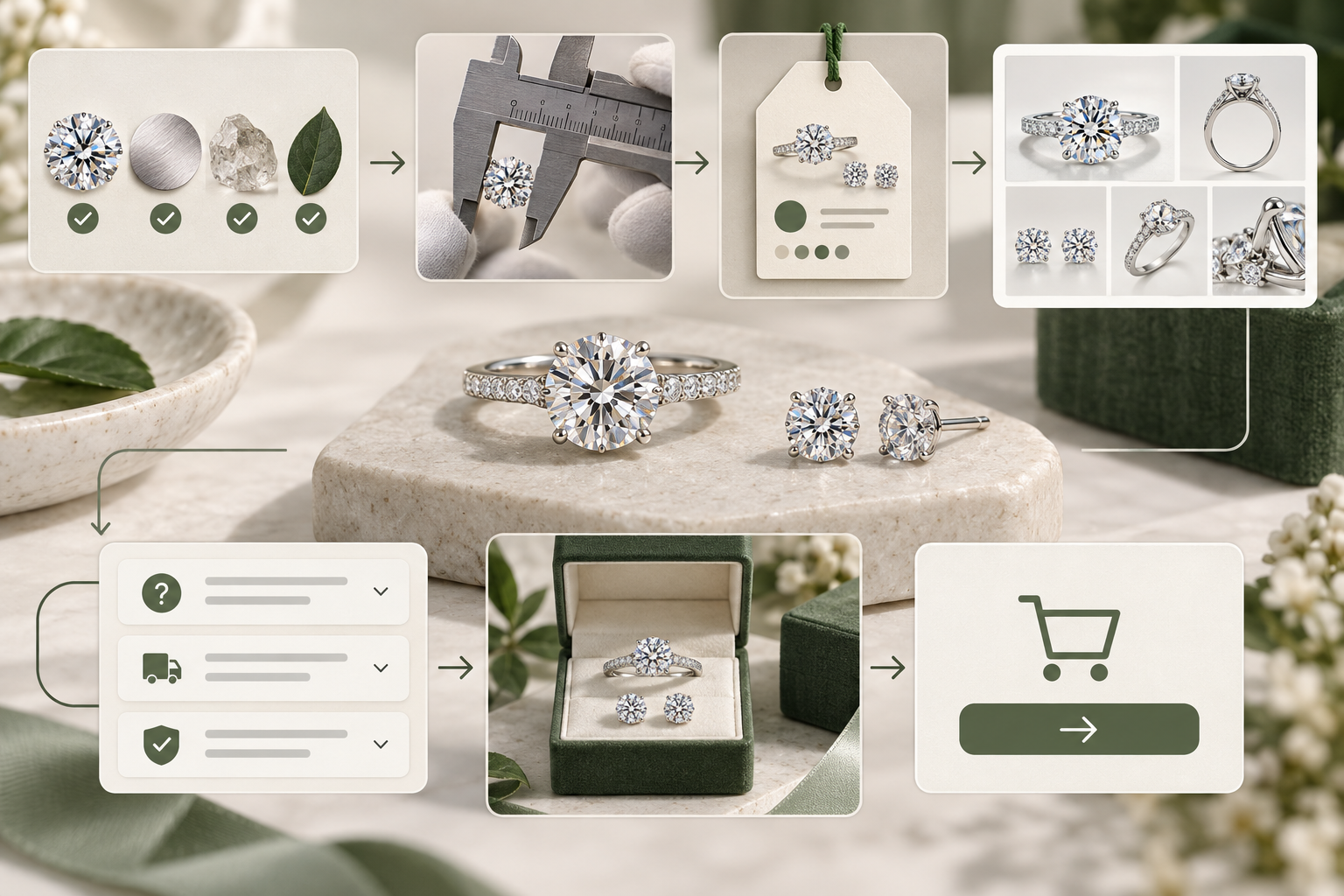
1. Start with a specific, scannable product title
A useful title tells the buyer what the item is without forcing them to open the description. A practical order is:
Design or stone + product type + base metal + finish + meaningful size detail
For example, “Six-Prong Moissanite Solitaire Ring in Gold-Plated S925 Silver” is more informative than “Classic Sparkle Ring.” The descriptive version gives search engines, AI systems, and buyers several verified attributes immediately.
- Use the product type customers actually search for: ring, stud earrings, tennis necklace, pendant necklace, or bracelet.
- Include the stone and base metal when they are verified.
- Add a finish such as gold-plated or rhodium-plated when applicable.
- Reserve promotional language for the description; keep the title factual.
- Avoid “diamond” as a substitute for moissanite. The FTC’s gemstone guidance explains that moissanite is not the same as a mined diamond.
2. Build a verified product-data block
Make essential specifications easy to scan. This block is useful for customers, customer-service teams, marketplace feeds, and AI-generated answers. Include only fields supported by the product record or supplier documentation.
| Field | What to record | Why it matters |
|---|---|---|
| Product type | Ring, earrings, necklace, bracelet, or chain | Supports navigation and search intent |
| Stone | Moissanite and verified shape or configuration | Prevents material confusion |
| Base metal | For example, S925 sterling silver | Helps buyers compare value and care |
| Finish | Gold-plated, rhodium-plated, or unplated when verified | Sets appearance and care expectations |
| Dimensions | Stone size, width, length, and other relevant measurements | Adds scale and reduces ambiguity |
| Construction | Setting, prongs, closure, links, or chain style | Supports quality evaluation |
| What is included | Pair, single piece, chain included, or pendant only | Reduces order misunderstandings |
If a product has several variants, connect each variant to its own SKU, image, finish, size, and available quantity. This is particularly important for rings, tennis jewelry with multiple widths, and pieces offered in more than one color finish.
3. Use images that answer buying questions
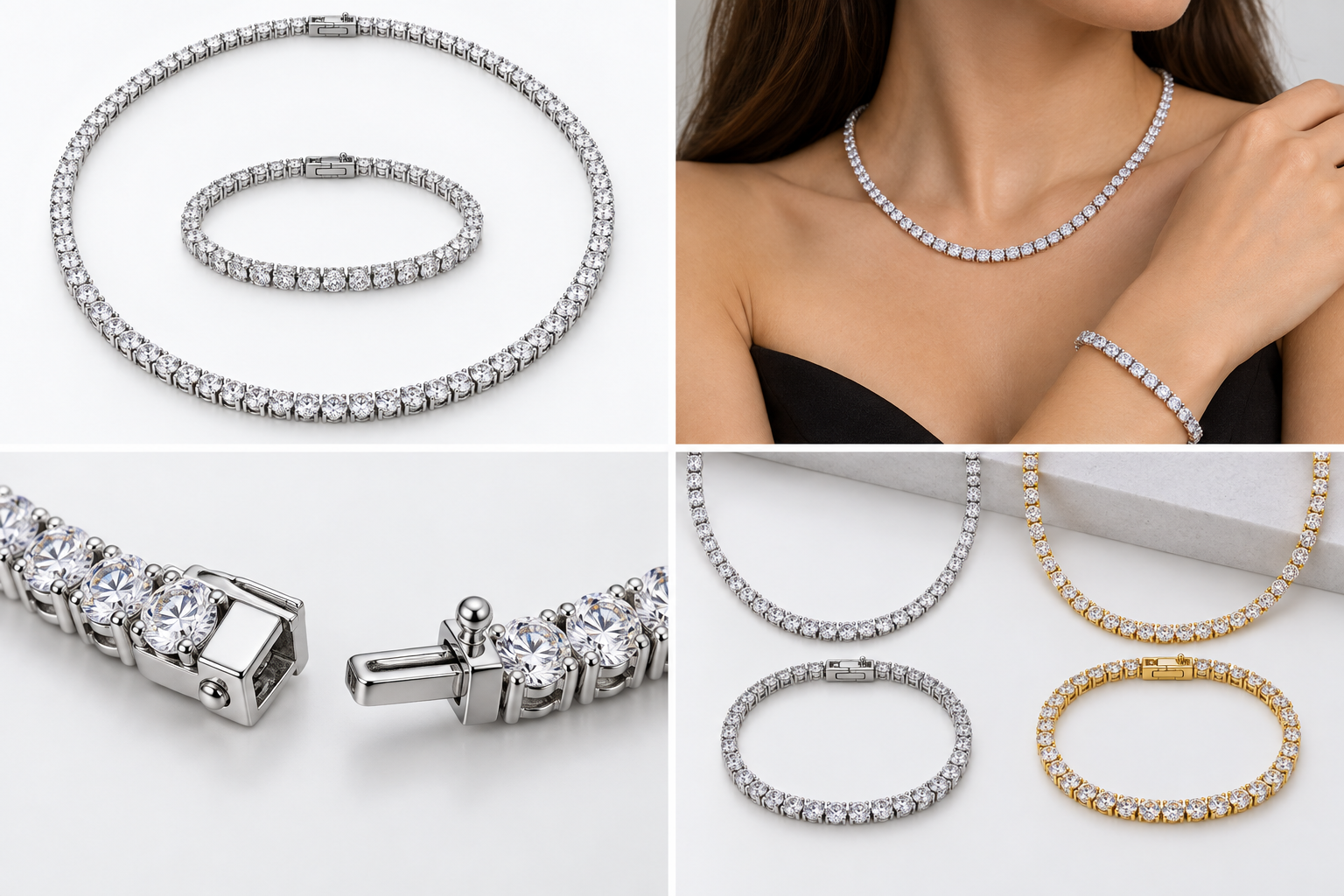
A holiday-ready gallery should help the shopper understand appearance and construction without relying on imagination. Aim for a logical sequence rather than a collection of near-duplicate views.
- Primary image: the complete piece on a clean background.
- Angle or side view: setting height, prongs, basket, links, or clasp.
- Scale image: worn on a hand, ear, neck, or wrist when available.
- Detail image: finish, stone arrangement, closure, or construction.
- Variant image: a clear visual for each material, finish, or size option that looks different.
Write alt text for the image that is actually shown. “Round moissanite six-prong stud earrings in rhodium-plated S925 silver, front pair view” is more useful than “jewelry image.” Do not stuff the same keyword into every image.
4. Write for comparison, not just inspiration
Holiday customers often compare several items in one session. Give them a short description that explains who the piece may suit, followed by objective specifications. Then link to close alternatives so they can compare without leaving your site.
For example, a retailer can create a compact comparison path with:
- A gold-plated six-prong moissanite solitaire ring for shoppers browsing classic ring silhouettes.
- rhodium-plated six-prong moissanite stud earrings for a versatile gift category.
- A graduated moissanite tennis necklace in S925 sterling silver for a higher-impact neckline option.
- A round moissanite tennis bracelet with multiple width options for shoppers comparing scale.
These links should support a decision, not simply distribute keywords. A ring page can link to the moissanite rings collection; an earring page can link to moissanite earrings; and a tennis necklace page can lead to tennis necklaces.
5. Add concise answers to high-intent questions
Product-page FAQs can clarify details that influence purchase decisions. They also organize information in a format that search engines and AI tools can interpret more easily. Good questions are specific to the SKU and answerable from verified information.
- What is the base metal?
- Is the piece plated, and what color is the finish?
- Is the listing for one earring or a pair?
- Which sizes, widths, or lengths are available?
- How should the piece be stored and cleaned?
- Does the pictured chain come with the pendant?
- When will the item ship, and is that timing confirmed for this SKU?
Do not reuse the same generic answer everywhere if product construction differs. A concise, correct answer is more valuable than a long answer built from assumptions.
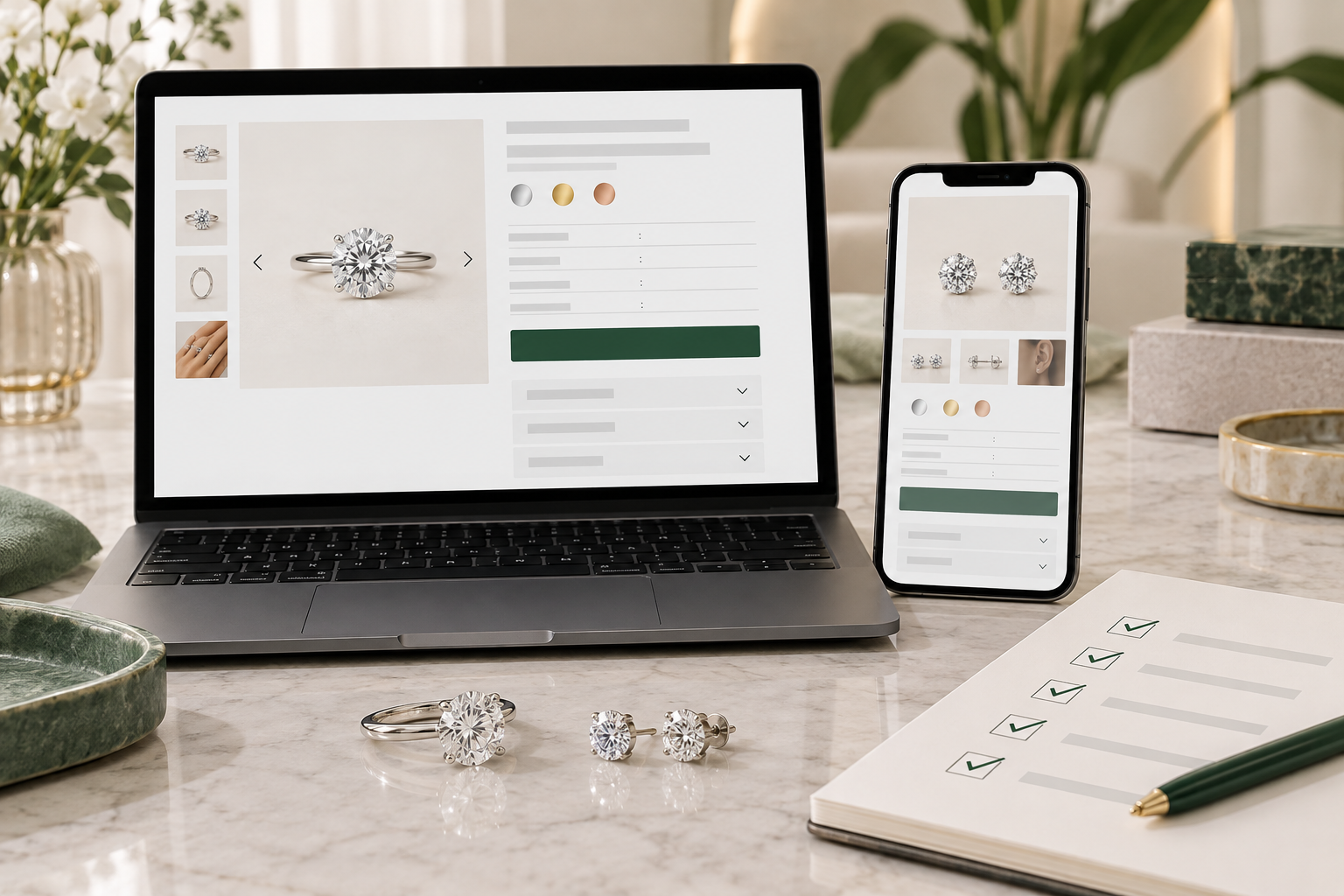
6. Keep merchandising data consistent across channels
Use the same verified naming rules on your website, marketplace feeds, email campaigns, social posts, and in-store reference sheets. Consistency makes it easier for staff and customers to match a marketing image to the correct item.
Before a holiday campaign goes live, compare these fields across channels:
- Product title and SKU
- Stone and base metal
- Finish or plating
- Size, width, and length
- Price and promotion terms
- Availability and fulfillment timing
- Image-to-variant assignment
If information cannot be verified, remove or qualify the claim before launch. Accurate product data protects trust and makes future content updates faster.
7. Finish with a useful call to action
Match the call to action to the page. A category page can invite shoppers to compare styles; a product page can ask them to select a size or finish; a wholesale resource can direct qualified buyers to create an account.
LEKANI serves jewelry businesses worldwide with wholesale jewelry fulfilled from our U.S. or China warehouse, as shown on each product page. A first order must reach US$99 per warehouse before shipping and tax; eligible products can be mixed, with a minimum of one piece per SKU. After the first completed order, reorders have no minimum order value.
Holiday product-page QA checklist
- Title names the actual product, stone, metal, and finish.
- Every specification is verified for the selected SKU.
- Variant names, images, and inventory status agree.
- The gallery shows the full piece, scale, and important construction details.
- Alt text describes each image accurately.
- FAQs answer real purchase questions without unsupported claims.
- Internal links lead to relevant alternatives, categories, and wholesale information.
- Price, promotion, shipping, and availability language is current.
- The mobile page is easy to scan and the main CTA is visible.
Frequently asked questions
What is the most important information on a jewelry product page?
The essentials are the product type, stone, base metal, finish, relevant dimensions, size or length options, construction or closure, what is included, accurate images, and current availability. These fields help customers compare products and reduce ambiguity.
How long should a jewelry product description be?
There is no universal ideal length. Use enough copy to explain the product’s verified features and buying considerations, then present specifications in a scannable format. Avoid padding the page with repeated keywords or unverified benefits.
How can jewelry retailers make product pages easier for AI shopping tools to understand?
Use consistent product names, clear headings, explicit materials and dimensions, accurate variant data, descriptive image alt text, concise FAQs, and relevant internal links. Information should agree across the product page, collection page, feeds, and promotional content.
Should moissanite be described as a diamond?
No. Moissanite is a distinct gemstone and should be identified accurately. Retailers should not use “diamond” as a substitute for moissanite or make product claims that could confuse shoppers about the stone being sold.
Can approved LEKANI wholesale customers use LEKANI product images?
According to LEKANI’s Wholesale FAQ, approved wholesale customers may use authorized LEKANI product images and descriptions for resale, provided the materials, stones, plating, branding, and product details are represented accurately.


