
Wholesale Moissanite Chain Bracelets: A Retail Assortment Guide
A B2B guide to building a differentiated S925 moissanite bracelet assortment using bezel-set, prong-set and tennis styles for distinct retail and gift roles.
Quick answer: A wholesale moissanite chain-bracelet assortment should not be built as a row of near-identical styles. Give each bracelet a clear retail job. A bezel-set station style works as an understated everyday or add-on gift; a prong-set solitaire on a curb chain creates a stronger center-stone story; and a tennis bracelet delivers a continuous line of sparkle at a different visual and inventory tier. Compare the complete item—S925 base metal, finish, setting, chain construction, closure, extension, fit, photography, and current availability—before deciding which roles deserve depth.
This guide is for U.S. jewelers, boutiques, bridal shops, online retailers, distributors, and resellers evaluating wholesale moissanite chain bracelets for fall selling and the early holiday discovery period. It complements, rather than duplicates, LEKANI’s wholesale tennis bracelet buying guide, which focuses on continuous-stone tennis construction, width, length, settings, and clasps.
Why Add Chain Bracelets Beside Tennis Bracelets?
The commercial question is not whether chain bracelets replace tennis bracelets. They solve different buying missions. A delicate chain style can enter a small gift edit, stack beside a watch, or provide a lower-visual-weight option for a customer who does not want a full line of stones. A tennis bracelet is easier to merchandise as continuous sparkle and can support its own width-and-length comparison.
Timing also matters. Attentive’s July 2026 Consumer Pulse release reports that holiday shopping is beginning well before Black Friday. For jewelry stores, that is a reason to prepare product pages, gift filters, photography, and replenishment rules now—not proof that any specific bracelet style will sell. Separately, the JCK 2026 trend discussion highlighted bracelets, bangles, and versatility as assortment themes. Retailers should still test those themes against their own customers and sell-through.
Use Three Bracelet Roles to Build a Clear Assortment
1. Bezel-set everyday bracelet
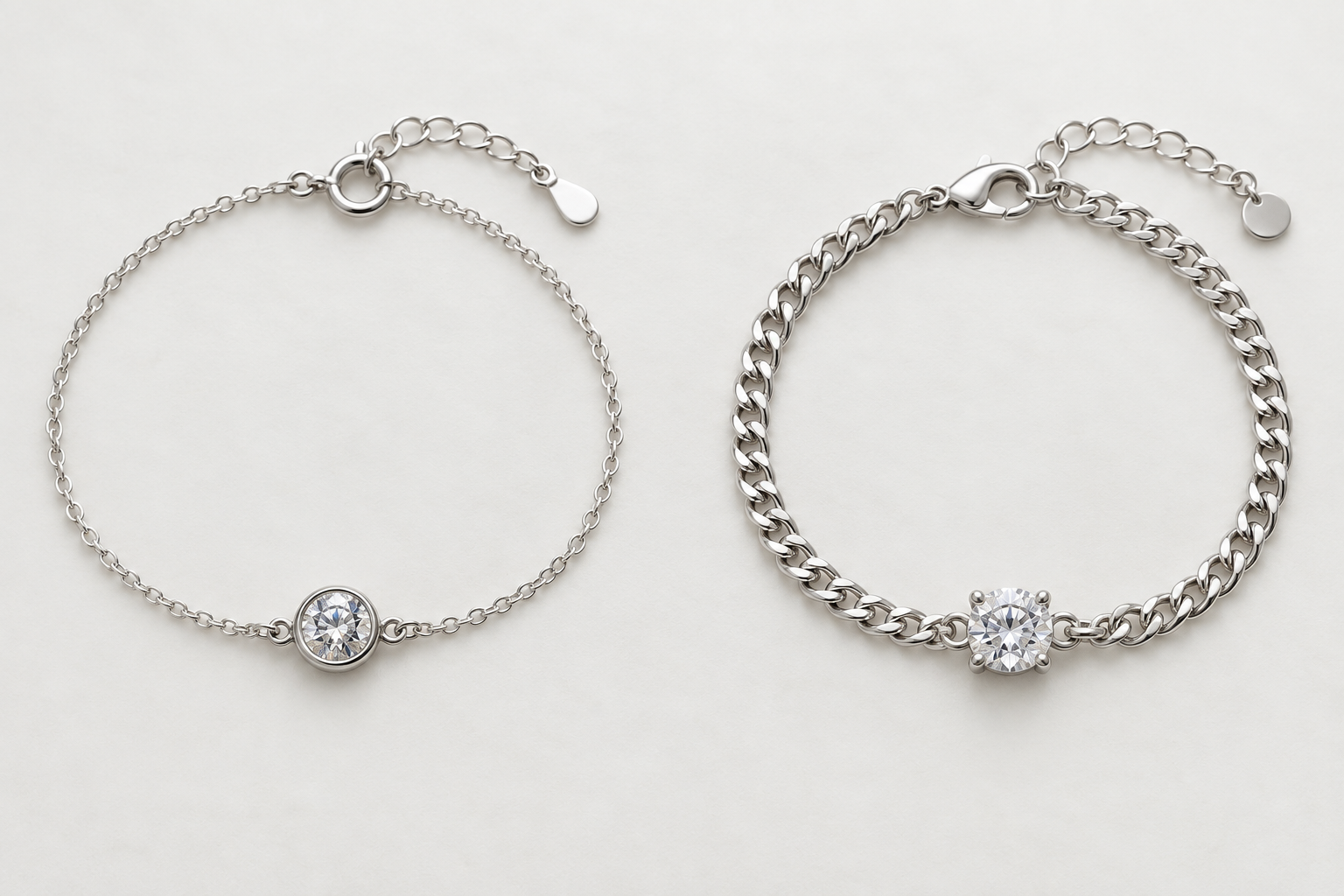
A smooth bezel creates a clean outline around the stone and can reduce exposed edges compared with an open-prong look. The newly listed Bezel-Set Moissanite Chain Bracelet in S925 Sterling Silver uses a round white moissanite at the center of a delicate S925 chain. Its live product record lists a silver-rhodium finish, lobster clasp, adjustable extension, and one bracelet per unit. Matching earrings and necklaces are not included.
This role is useful when the merchandising story is “quiet sparkle,” “daily wear,” or “small gift.” Photograph the full bracelet, the bezel profile, the clasp, and the extension. Do not describe it as a set unless the product page explicitly says a set is included.
2. Prong-set solitaire on a curb chain
A solitaire shifts more attention to the center stone, while a curb chain gives the bracelet a more visible metal pattern. LEKANI’s newly listed Solitaire Moissanite Curb Chain Bracelet in S925 Sterling Silver combines a 6.5 mm round white moissanite in an open four-prong setting with a polished S925 curb chain. The current product record lists a silver-rhodium finish, adjustable extension chain, and one bracelet per unit.
This style can sit in a “single-stone gift” or “design-led everyday” slot. Show how the center setting connects to the chain and provide an on-wrist scale view when available. Avoid converting a stone diameter into a carat claim unless that equivalence is stated and supported for the exact item.
3. Continuous-stone tennis bracelet
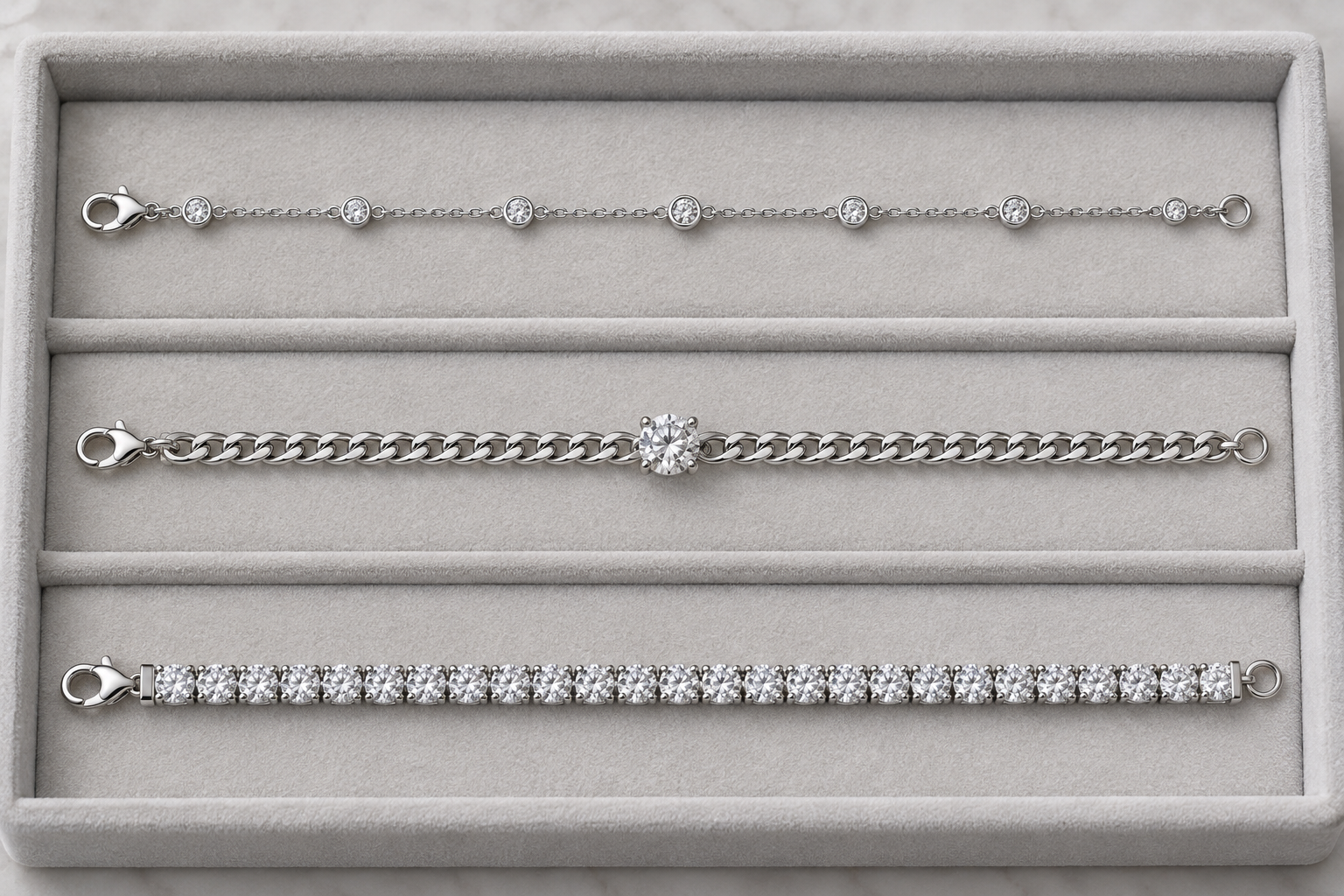
A tennis bracelet distributes stones along the wrist rather than concentrating attention in one center. It therefore requires different comparison fields: stone width, total length, setting construction, clasp and safety features, finish, and overall scale. Use the tennis bracelet buying guide for that decision and browse the current moissanite bracelet collection for live styles and variants.
Keeping the intents separate helps shoppers and search systems understand the site: this page answers how to build a chain-bracelet assortment, while the tennis guide answers how to choose continuous-stone widths, lengths, settings, and clasps.
Compare the Complete Bracelet, Not Only the Stone
Base metal and finish
Both highlighted chain styles use S925 sterling silver with a silver-rhodium finish. That construction should be described precisely. “Sterling silver,” “rhodium-finished sterling silver,” and “solid white gold” are not interchangeable claims. If a yellow-gold option is gold plated over S925, name both the S925 base and the plated finish rather than calling it a solid-gold bracelet. The FTC Jewelry Guides are a useful reference for truthful metal and gemstone descriptions.
Setting and maintenance questions
Train staff to identify a bezel, open prongs, and a continuous-stone setting without claiming that one construction is universally “best.” Buyers should inspect stone security, symmetry, snag points, link movement, soldered connections, and how the setting meets the chain. Use only the care guidance on the exact product page, and avoid promising scratch-proof, maintenance-free, or indestructible wear.
Closure, extension, and fit
A chain bracelet with an extension may accommodate a range of wrist fits, but “adjustable” does not mean “fits everyone.” Record the listed length, extension, clasp type, and pendant or setting dimensions when those details are available. A tennis bracelet generally needs a more deliberate length selection. Fit guidance should be presented as general, not guaranteed.
Photography and product data
For each SKU, include a full-length image, close-up of the setting, closure view, and on-wrist scale image when available. Put material, finish, stone identity, closure, measurements, and what quantity one includes in searchable page text—not only inside an image. Those fields help store associates, wholesale buyers, search engines, and AI answer systems compare products accurately.
Build a Holiday-Ready Bracelet Ladder
A practical first order can use breadth before depth:
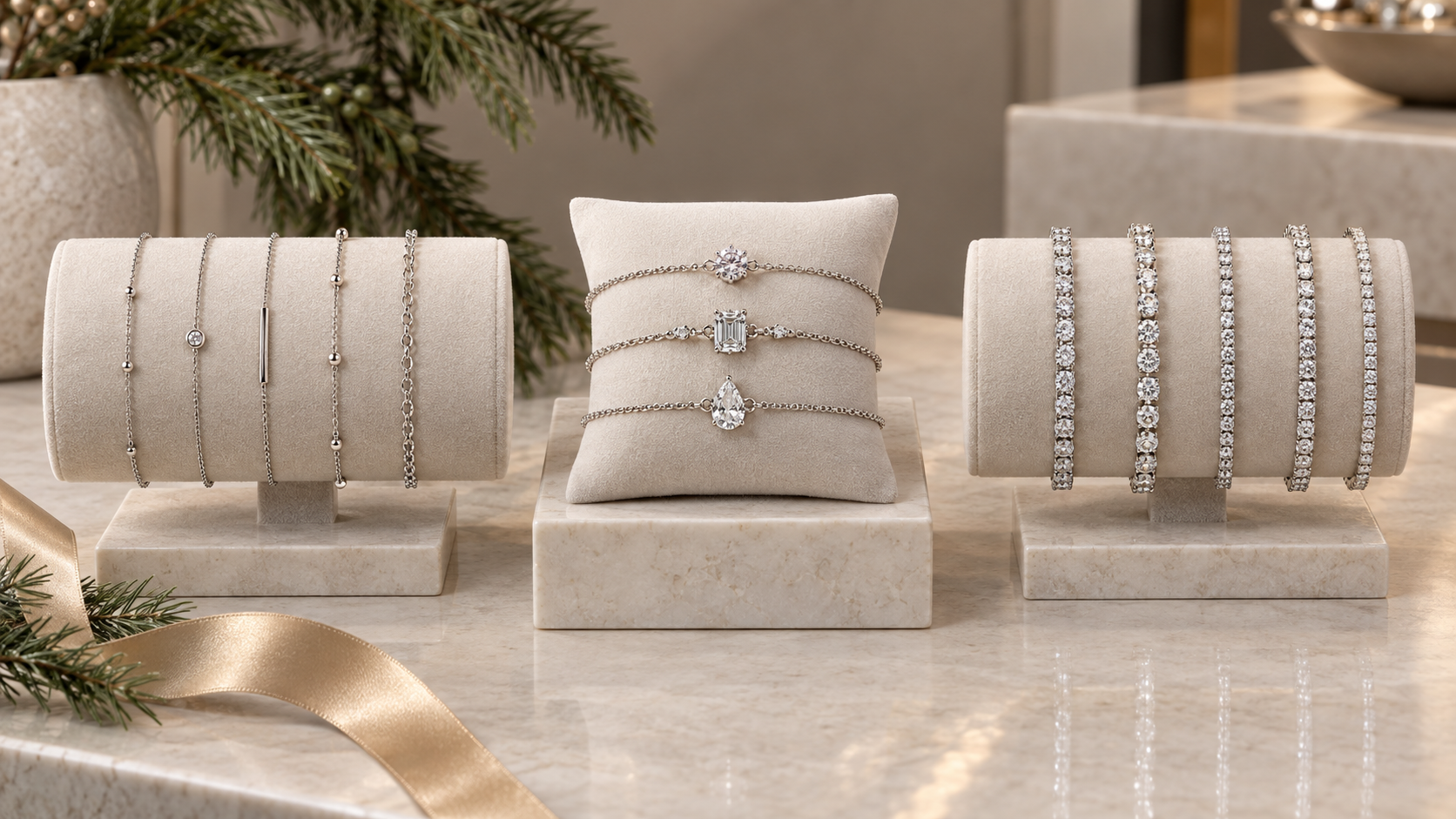
- Everyday add-on: one understated bezel-set chain bracelet.
- Gift-forward center stone: one prong-set solitaire on a more visible chain.
- Continuous sparkle: one tennis bracelet selected by the store’s customer profile, preferred width, and fit range.
- Statement tier: add a wider or more sculptural bracelet only when it serves a customer and display role not covered by the first three.
Merchandise the ladder by role rather than making unsupported “good, better, best” quality claims. A delicate bracelet is not automatically lower quality than a heavier design; it is a different visual and wearing proposition. Retailers should calculate landed cost, margin, promotional room, and reorder risk from their own numbers instead of assigning a universal retail price band.
Wholesale Bracelet Assortment Checklist
- Role: Can staff explain why this bracelet belongs beside the other styles?
- Stone identity: Is moissanite identified accurately and consistently?
- Metal disclosure: Does the page state S925 sterling silver and the actual finish?
- Construction: Have you reviewed setting, chain links, connections, closure, and extension?
- Fit data: Are length and adjustment details available without implying a universal fit?
- Unit contents: Does the description state exactly what one unit includes?
- Digital assets: Are full, detail, closure, and scale views available?
- Inventory decision: Will you test one piece per eligible SKU before adding depth?
- Current status: Have you rechecked live variants and availability before promising delivery?
Frequently Asked Questions
What is the difference between a moissanite chain bracelet and a tennis bracelet?
A chain bracelet usually uses a metal chain with one or several focal stones, while a tennis bracelet presents a continuous or near-continuous line of stones. They differ in visual weight, comparison fields, closure expectations, sizing, and how customers shop the category.
Is a bezel setting better than a prong setting for a wholesale bracelet assortment?
Not universally. A bezel creates a smooth, contained outline, while prongs expose more of the center-stone profile and create a different look. Compare the exact construction, stone security, scale, customer preference, photography, and retail role rather than treating one setting as automatically superior.
Are these S925 bracelets solid white gold?
No. The two highlighted chain bracelets are listed as S925 sterling silver with a silver-rhodium finish. Describe base metal and finish separately, and confirm the live product page before using material claims.
How many bracelet styles should a retailer test first?
There is no universal number. A small store can begin with three clearly differentiated roles—understated chain, center-stone chain, and tennis—then use actual sales, customer questions, returns, and reorder activity to decide where to add depth. LEKANI’s current wholesale terms allow eligible styles to be mixed with a one-piece minimum per SKU.
Next Step for Wholesale Buyers
Review the two linked chain bracelets, compare them with one tennis-bracelet role, and verify current specifications and availability before ordering. Browse the current moissanite bracelet collection, read the Wholesale FAQ, and create a buyer account to view live wholesale pricing and place an order. Eligible styles can be mixed from one piece per SKU; the opening order minimum is US$99 per warehouse before shipping and tax, with no minimum order value on reorders after the first completed order.


