
Wholesale Moissanite Earrings & Stud Earrings Buying Guide
Compare wholesale moissanite earrings and stud earrings by stone dimensions, matched-pair consistency, settings, posts, backs, 925 silver finish, packaging, and retail role.
Wholesale moissanite earrings can give jewelers, boutiques, bridal stores, and online retailers an accessible entry into a high-sparkle gemstone category. Studs are easy to merchandise for everyday wear and gifting, while halo, hoop, and drop styles can create clear trade-up steps without the size-depth requirements of a ring program.
A productive assortment still depends on exact specifications. Buyers should compare stone identity and dimensions, matched-pair consistency, setting construction, post and back type, 925 sterling silver and surface finish, finished weight, packaging, photography, and reorder consistency before adding depth.
Quick buying answer
- Start: choose one core round stud size in a verified 925 sterling silver setting.
- Build: add a smaller everyday size and a larger gift or occasion size.
- Trade up: introduce halo, hoop, drop, or matching-set designs only after the core studs have a defined retail role.
What Should a Wholesale Buyer Verify First?
Begin with the product record, not the promotional name. “Moissanite earrings” should identify the stone as moissanite and describe the metal, finish, dimensions, setting, and components separately. Moissanite is a different gemstone from diamond. It should not be presented as a natural diamond or a laboratory-grown diamond.
For each earring SKU, request:
- Stone identity, shape, cut style, millimeter dimensions, and quantity
- Actual stone weight where supplied, clearly separated from any comparison weight
- 925 sterling silver base metal verification
- Rhodium, gold-tone, rose-gold-tone, or other plating and finish information
- Setting style and number of prongs or other stone-retention features
- Post material, post length and thickness, and back type
- Finished weight per pair or per earring, with the unit clearly labeled
- Pair-matching, inspection, packaging, and reorder standards
The Federal Trade Commission’s Jewelry Guides emphasize truthful descriptions of gemstones and precious metals. The FTC also warns that some basic thermal diamond testers can register moissanite as diamond, so a positive thermal test alone should not be used to identify or market the stone as diamond.
Choose Earring Styles by Retail Role
A focused opening assortment is easier for staff and customers to understand than a wide group of unrelated designs. Assign each style a specific role before ordering depth.
| Style | Useful retail role | What to verify |
|---|---|---|
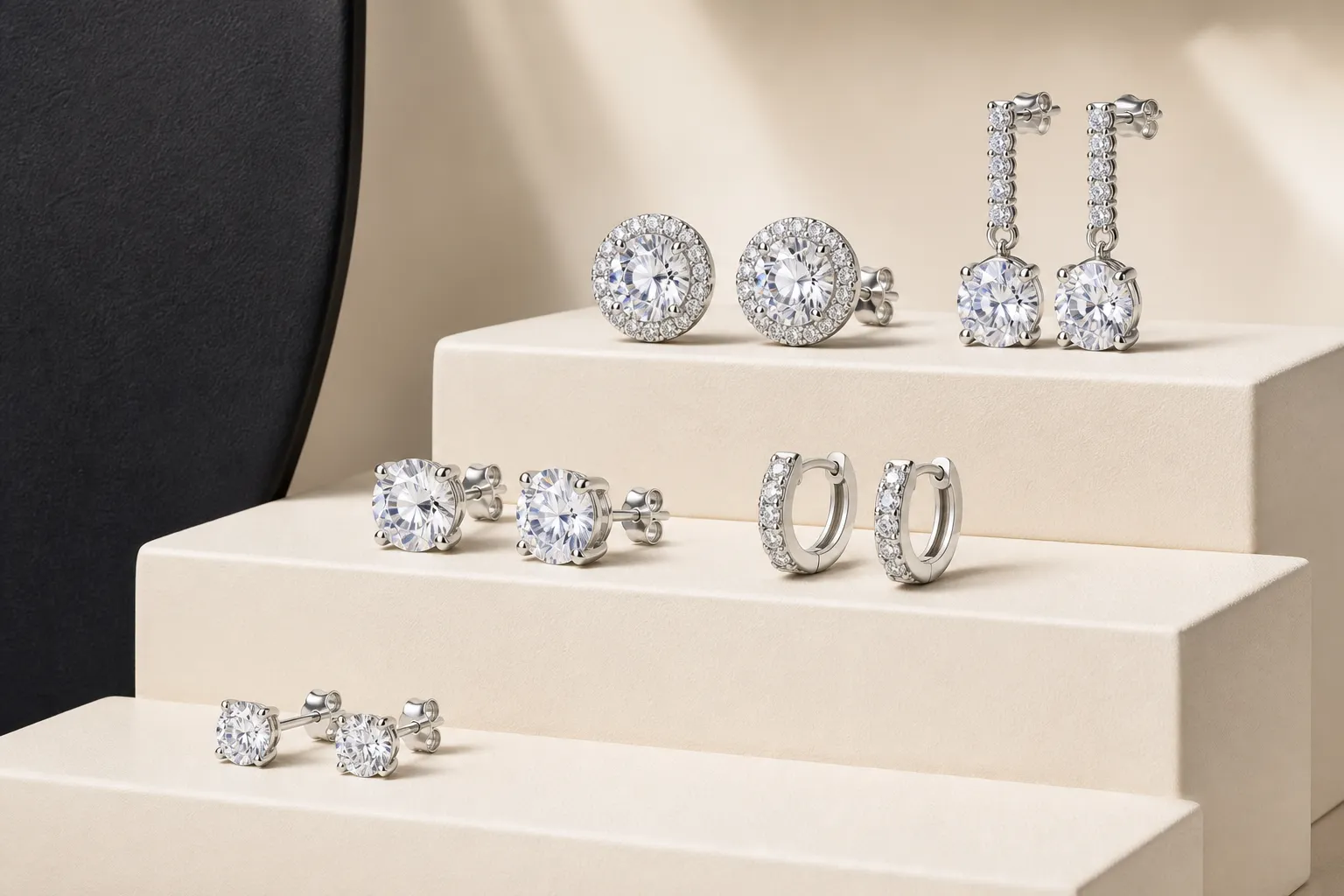
| Round solitaire studs | Everyday, gift, bridal, opening assortment | Stone dimensions, setting height, post, back, pair match |
| Halo studs | Visible trade-up and occasion | Center and accent identity, halo alignment, total dimensions |
| Hoops or huggies | Fashion, self-purchase, layering | Hinge, closure, inside diameter, stone orientation, left/right match |
| Drop earrings | Bridal, event, premium gift | Total length, movement, joint security, weight, left/right orientation |
| Coordinating set | Add-on and matching-set merchandising | Stone scale, finish color, design consistency, separate SKU data |
Stud earrings generally provide the cleanest starting point because the comparison can be organized around stone size, setting, finish, and component quality. Hoops and drops add fashion and occasion value, but they also introduce more hinges, joints, movement, and orientation checks.
Build a Stone-Size Ladder Using Millimeters
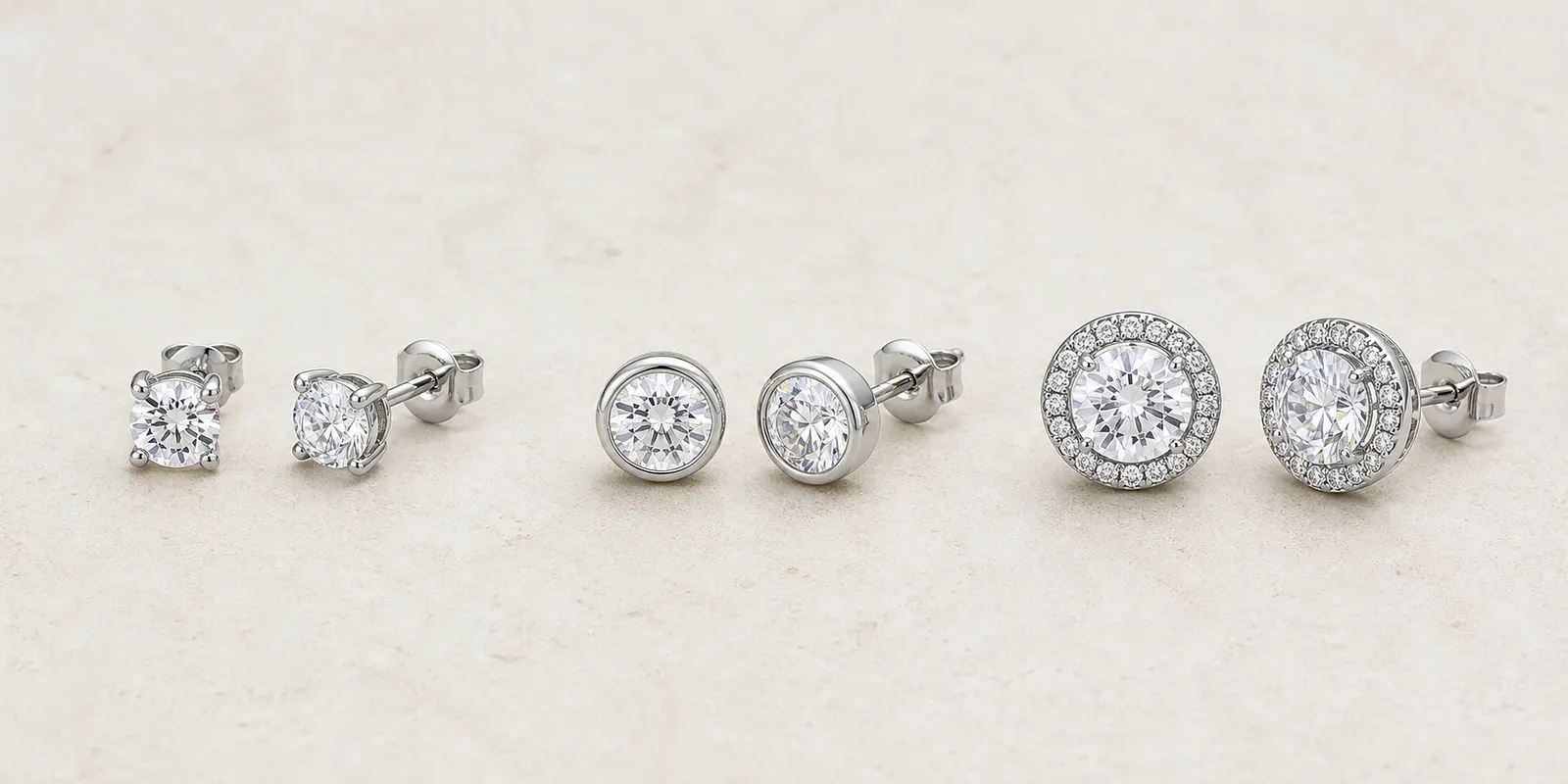
Use millimeter dimensions as the primary visual size reference. A customer can compare a 4 mm, 5 mm, or 6 mm round stone more consistently when the listing provides the actual diameter. If a supplier also provides an equivalent comparison, label it clearly and do not substitute it for the moissanite’s actual identity, dimensions, or weight.
A practical stud program can include three roles rather than many overlapping sizes:
- Delicate: a smaller profile for subtle everyday wear, second piercings, or accessible gifting
- Core: the main presentation size intended to carry the most inventory depth
- Statement: a larger or halo-enhanced profile for visible gifts, bridal, or occasion use
The exact dimensions should come from the active assortment and customer history. Do not assume that one size ladder is correct for every store. Photograph each size at the same scale and angle so customers can compare the visible difference.
Inspect Matched-Pair Consistency
Earrings are sold and worn as pairs, so consistency is a core quality requirement. Inspect both pieces together under the same neutral lighting.
- Stone dimensions and visible face-up size should match.
- Color appearance and cutting pattern should be reasonably consistent.
- Settings should sit at the same height and angle.
- Prongs, halos, and borders should have the same shape and spacing.
- Posts should be straight, centered, and aligned.
- Backs should engage with similar resistance.
- Left/right designs should mirror correctly.
- Finish color and polish should match across the pair.
Record whether the supplier matches pairs during production, inspection, or packing. For reorders, ask how stone scale, finish color, setting profile, and component specifications are kept consistent with earlier inventory.
Compare Settings and Profile Height
The setting changes the earring’s appearance, comfort, light exposure, and service needs. A low-profile basket may sit closer to the ear, while a taller setting may increase visibility but requires careful evaluation of balance and post placement.
Prong settings
Check that every prong contacts the stone and that tips are smooth, consistent, and not visibly lifted. Compare the stone’s position from the front and side. Uneven prongs or an off-center stone are easier to detect when both earrings are placed side by side.
Bezel or border-style settings
Inspect the edge for consistent contact, symmetry, and a smooth finish. Confirm whether the design is a true bezel, a bezel-like border, or another construction so product descriptions remain accurate.
Halo and multi-stone settings
Verify the identity and dimensions of both the center and accent stones. Check the complete halo for gaps, uneven height, loose accents, and asymmetry. A product title should not imply that every visible stone is moissanite unless the specification supports that statement.
Verify Posts, Backs, Hinges, and Closures
Component details can influence comfort, returns, and replacement requests. Do not describe an earring simply as “925 silver” without clarifying whether the claim applies to the setting, post, back, or all components.
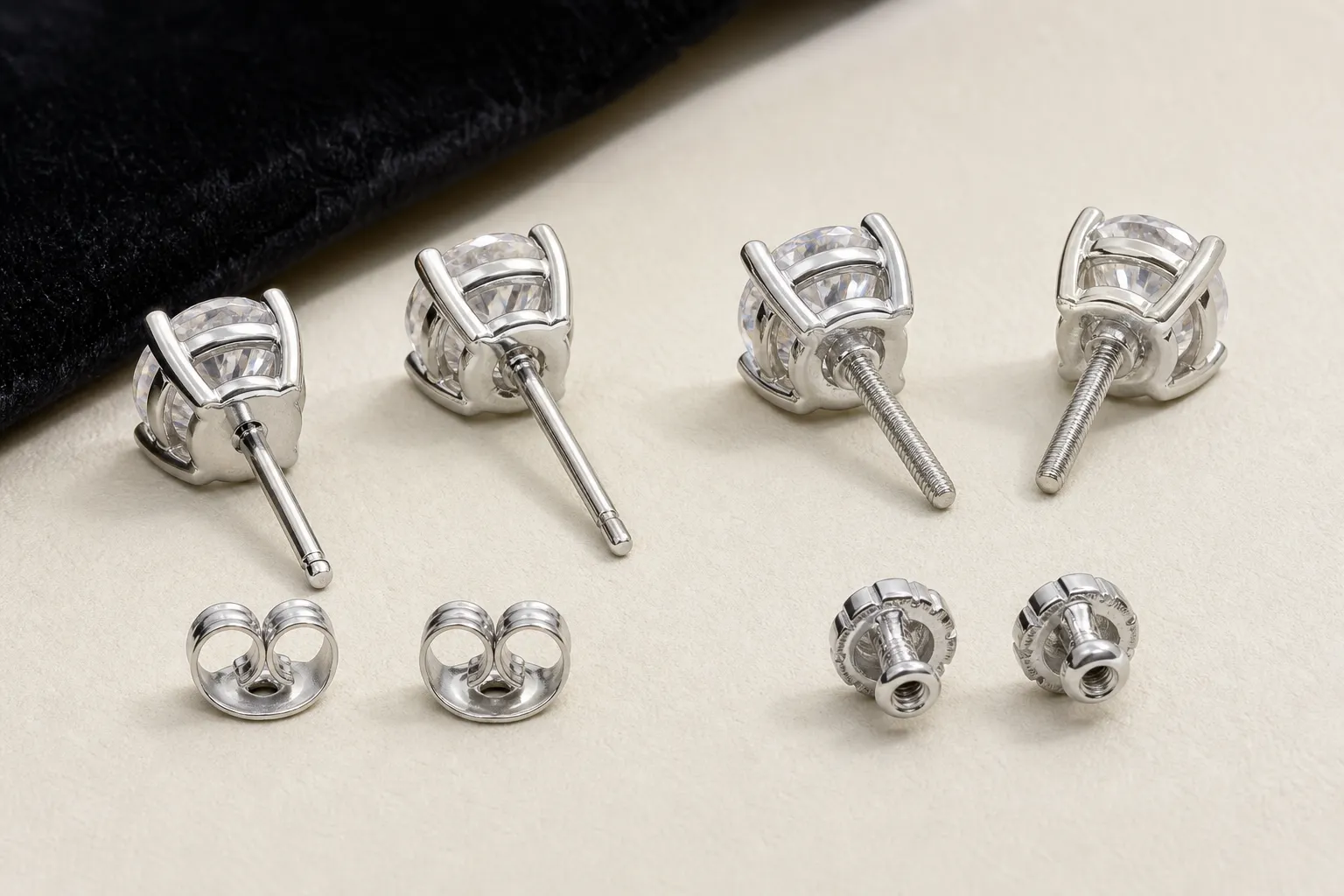
Common backs may include friction or butterfly backs, screw backs, and other locking systems. For hoops and huggies, inspect the hinge and closure instead of relying on the style name alone.
- Confirm post material, length, thickness, and threading where applicable.
- Check that posts are straight and securely joined to the setting.
- Test that backs hold securely without excessive force.
- Record whether replacement backs are available.
- For screw backs, inspect thread engagement and ease of use.
- For hoops, test hinge movement and closure alignment repeatedly.
- Avoid unsupported “hypoallergenic” claims.
Document 925 Silver and Surface Finish Separately
For 925 silver moissanite earrings, identify sterling silver as the base metal and record any surface treatment separately. A white finish may involve rhodium or another plating; yellow and rose colors may use different plated finishes. The product page should not imply that a plated color is solid gold.
Ask for the finished metal or total jewelry weight and define the field consistently. Care instructions should address both sterling silver and the applied finish. Avoid promises that silver will never tarnish or that a plated finish will never change.
Prepare Product Data and Photography Before Launch
Complete product data helps online retailers reduce uncertainty and gives search engines and AI systems specific facts to understand. Use the same field structure across the assortment.
- Clear product title using “moissanite” and “925 sterling silver” where verified
- Style: stud, halo stud, hoop, huggie, or drop
- Stone shape, dimensions, quantity, and identity
- Overall earring dimensions and setting height
- Base metal, plating, finish color, and component materials
- Post, back, hinge, or closure specifications
- Finished weight per pair or per earring
- Care instructions and what any certificate or report covers
Photograph the pair from the front, side, and back. Add a close view of the setting, post, back, hinge, or closure; a scale reference; and a consistent comparison of available sizes. Matching-set images can support merchandising, but each SKU still needs its own complete specifications.
Plan the Assortment for Fall and Holiday Gifting
Late August is a useful time for U.S. retailers to prepare Q4 product data, photography, displays, email segments, and replenishment lists. LEKANI’s wholesale jewelry holiday planning calendar recommends using August and September to build the Q4 foundation and October to launch holiday discovery.
For earrings, organize the opening buy by retail role rather than treating every design as equal:
- Core: a matched round stud with the clearest everyday and gift role
- Accessible: a smaller stud or refined profile for opening-price gifting
- Trade-up: a larger stud, halo, or more substantial setting
- Occasion: one bridal or event-focused drop or hoop design
- Add-on: one coordinating pendant or set where specifications match
Buy the greatest depth in the core style. Test seasonal and statement designs in smaller quantities until customer requests and sell-through support reorders. Prepare product pages before traffic becomes promotion-driven.
Use a Repeatable Receiving Inspection
Inspect incoming earrings by SKU and pair before they are photographed, displayed, or shipped to customers.
- Confirm the SKU, stone identity, metal, finish, and quantity against the purchase record.
- Compare the two earrings face up for size, color appearance, symmetry, and setting height.
- Inspect prongs, borders, halos, joints, and hidden areas under magnification.
- Check posts for alignment and test each back or closure.
- Compare finish color and polish across the pair.
- Record defects and isolate affected pieces before photography or fulfillment.
- Retain an approved reference sample or specification record for future reorders.
Questions to Ask a Wholesale Moissanite Earring Supplier
- How is the stone identified, and what does the testing method establish?
- What are the shape, millimeter dimensions, quantity, and actual weight where supplied?
- How are pairs matched for dimensions and visible appearance?
- Is the setting verified as 925 sterling silver?
- What are the plating, finish, post, and back materials?
- What are the overall dimensions, setting height, post dimensions, and finished weight?
- How are prongs, posts, backs, hinges, and closures inspected?
- Are replacement backs or components available?
- How consistent are stone size, finish color, settings, and components across reorders?
- What product images, specification data, opening-order terms, and reorder options are available?
Frequently Asked Questions
What should retailers compare when buying wholesale moissanite earrings?
Compare stone identity and millimeter dimensions, pair consistency, setting security, post and back type, base metal, plating, finished weight, comfort, photography, packaging, and reorder consistency.
Are moissanite earrings the same as diamond earrings?
No. Moissanite is a different gemstone from diamond. Product titles, descriptions, staff training, and packaging should identify it clearly as moissanite.
What is a practical opening assortment for moissanite stud earrings?
Many retailers can begin with a delicate size, one core size, and one larger or halo trade-up. The exact dimensions and inventory depth should follow the store’s customer history, price architecture, and supplier availability.
Which earring-back specifications should a buyer request?
Request the back type, material, size, fit, replacement availability, and any threading or locking details. Confirm whether the back and post use the same metal and finish as the setting.
How should moissanite earring size be listed online?
List the stone’s millimeter dimensions and quantity. If actual stone weight or an equivalent comparison is provided, label each field clearly and do not present a comparison as the moissanite’s actual weight or identity.
Why are matched-pair checks important?
Customers view earrings together. Differences in visible stone size, setting height, finish, post alignment, or back fit can be more noticeable across a pair and may contribute to returns or service requests.
Final Wholesale Buying Checklist
- Use moissanite as the clear stone identity.
- Verify 925 sterling silver and document plating separately.
- Build a controlled size ladder with clear retail roles.
- Inspect matched-pair appearance, settings, posts, backs, and closures.
- Record dimensions, weight fields, component materials, and care guidance.
- Prepare front, side, back, component, and scale photography.
- Buy depth in the core style and test fashion or occasion designs carefully.
- Confirm reorder consistency before promoting a long-term program.
Continue with LEKANI’s wholesale 925 silver moissanite jewelry buying guide, review the wholesale FAQ, or apply for a wholesale account to discuss current availability with the wholesale team.
References: The Federal Trade Commission’s In the Loupe and Jewelry Guides address truthful gemstone and precious-metal descriptions and warn that some thermal diamond testers may not distinguish moissanite. GIA’s gem imitation reference describes moissanite as a different gemstone from diamond and discusses its hardness and optical properties. This article provides general retail buying information and is not legal advice.


