
Small Business Saturday Jewelry Store Checklist: Inventory, Displays and Local Discovery
A six-week Small Business Saturday plan for independent U.S. jewelers and boutiques: verify giftable inventory, build useful displays, improve local discovery and prepare follow-up.
Small Business Saturday falls on November 28, 2026, the day after Black Friday. For an independent jewelry store, boutique or bridal retailer, it is more than a one-day promotion. It is a local discovery moment: shoppers may be deciding which neighborhood store to visit, whether an item feels gift-ready, and whether they can trust the store for later purchases, repairs, wedding jewelry or special occasions.
The U.S. Small Business Administration identifies Small Business Saturday as part of the holiday season and encourages consumers to support local businesses. American Express, which founded the event, also provides free Shop Small marketing materials for eligible use. That makes October the right time to prepare the operational pieces behind the message: verified inventory, clear gift choices, accurate local information, staff readiness and a follow-up plan.
This checklist is written for jewelry retailers that want to convert local attention without copying a broad Black Friday discount strategy.
Quick answer: What should a jewelry store prepare for Small Business Saturday?
A jewelry store should prepare six connected areas:
- A verified assortment of easy-to-understand gift categories.
- A simple good-better-best or core-feature-hero display structure.
- Accurate product pages, store hours, pickup information and contact details.
- Staff talking points that help shoppers choose without pressure.
- A promotion or value-add with clearly defined eligibility and margin limits.
- A follow-up path for customers who browse on November 28 but purchase later.
The best plan is not the largest assortment or deepest discount. It is the plan that helps a local shopper move from discovery to a confident choice while the retailer maintains accurate availability and healthy economics.
Why Small Business Saturday needs its own jewelry retail plan
Black Friday is commonly associated with broad promotions and comparison shopping. Small Business Saturday has a different customer context: community, local service, curation and the experience of buying from an independent business.
That distinction should influence the offer and the assortment. A jewelry store can emphasize:
- A curated gift edit rather than every SKU in the store.
- Personal assistance, appointments or gift guidance.
- Clearly stated pickup, shipping and special-order options.
- Packaging and presentation that are actually available.
- The store’s local service and long-term customer relationship.
If you are also running Black Friday or Cyber Monday offers, use the separate Black Friday jewelry promotion planning guide to set margin floors and SKU rules. The Small Business Saturday plan should remain easy to understand on its own.

Build a four-role giftable jewelry assortment
Instead of giving every style equal display space, assign each featured item a job. A practical Small Business Saturday edit can use four roles.
1. Entry gift: simple stud earrings
Stud earrings are compact, familiar and easy to compare. They can give a first-time customer a clear starting point without requiring the size decisions associated with rings.
The currently published Round Moissanite Six-Prong Stud Earrings in Rhodium-Plated Sterling Silver are one verified LEKANI example. The product is listed in the U.S. Shoplazza catalog and had positive tracked inventory when this guide was prepared. Retailers should confirm live availability before advertising any item as ready for immediate pickup or shipment.
For the entry gift role, verify:
- Metal and finish.
- Stone shape and setting style.
- Whether the product is sold as a pair.
- What packaging is included.
- Current availability and reorder timing.
2. Everyday gift: a solitaire pendant
A pendant necklace creates a second easy-to-understand category and can be merchandised as an everyday gift. It also gives staff a natural way to ask about preferred chain length, metal color and wearing style.
LEKANI’s published Round Moissanite Solitaire Pendant Necklace in S925 Sterling Silver is a current catalog example. Because inventory can change, use the product page and current stock record—not a static campaign draft—as the final source before promising fulfillment.
3. Distinctive gift: a design-led bracelet
A design-led bracelet helps the display feel curated rather than repetitive. The published Moissanite Charm Curb Chain Bracelet in Gold-Plated S925 Silver provides a warm-tone alternative to rhodium-plated staples and had positive tracked inventory at the time of review.
Use this role to test whether your customers respond to:
- Warm versus silver-white finishes.
- Classic versus design-led styling.
- Self-purchase versus gifting language.
- A coordinated display with earrings or necklaces.
4. Hero gift: a tennis bracelet
A tennis bracelet can act as the hero item that draws attention to the case or campaign. It does not need to be the highest-volume product to earn that role.
The current Round Moissanite Tennis Bracelet in S925 Sterling Silver is published with two listed length variants. It had positive tracked inventory when this article was prepared. Retailers should verify the exact length available before using phrases such as “ready today” or “available for pickup.”
Together, these four roles give the customer a useful comparison: familiar, everyday, distinctive and statement-level.

Use a core-feature-hero inventory model
A local event can create uneven demand, so avoid spreading stock equally across every style.
Core items
Core items have broad appeal, dependable product information and evidence of local demand. They deserve the strongest presentation quantity and the clearest reorder point.
Feature items
Feature items add visual variety or a different finish, shape or design story. They can begin with shallower depth until inquiries and sell-through justify more inventory.
Hero items
Hero items attract attention and support storytelling. They may be held in lower quantity, but the store must communicate whether the display piece is available, whether another length or finish can be ordered, and what fulfillment timing has actually been verified.
For every featured SKU or variant, record:
- On-hand quantity.
- Display quantity.
- Available sizes or lengths.
- Reorder point.
- Confirmed replenishment path.
- Whether online and in-store availability match.
- The customer-facing wording to use if the item sells out.
Do not advertise a category as “in stock” when only one unrelated variant remains.
Create three display zones that answer real questions
Shoppers should understand the display in seconds. A useful layout can use three zones.
Easy gifts
Place studs, simple pendants and other familiar styles together. Show the verified material, finish and what is included. Avoid making unsupported claims about value, durability or certification.
Curated local favorites
Use actual store evidence—sales history, appointments, wish lists or customer questions—to choose this group. “Favorite” should reflect something the store can explain, not an invented popularity claim.
Statement gifts
Use tennis jewelry or more distinctive designs to create visual impact. Make lengths, sizing and availability easy to find so the customer does not have to begin with a price-only question.
The display should use the same category names online and in store. That consistency helps shoppers who discover the store through search, social media or an AI assistant and then visit in person.
Prepare local discovery before November 28
Small Business Saturday performance starts before the shopper enters the store.
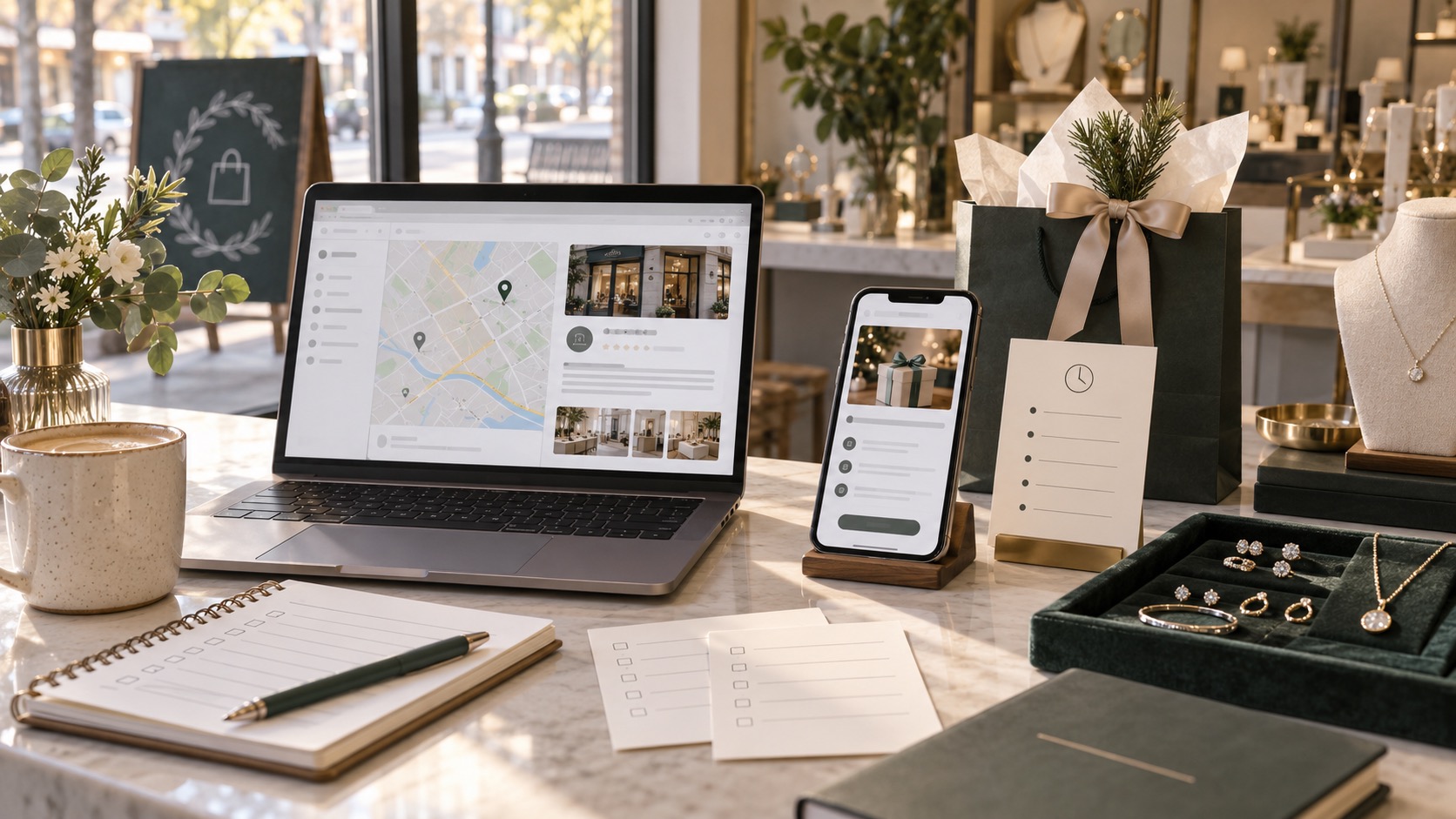
Verify your Google Business Profile
Google’s Business Profile guidelines allow businesses to specify special hours for holidays or special events. Confirm the address, customer-facing phone number, website, November 28 hours and any appointment requirements. Do not wait until the event morning to correct them.
If your website includes LocalBusiness structured data, Google Search Central documents openingHoursSpecification and seasonal date fields. Coordinate any website changes with the person responsible for your theme or technical SEO, and test the markup before release.
Create one event landing destination
Choose a page that answers:
- What is happening on November 28?
- Is the offer valid in store, online or both?
- What hours apply?
- Is an appointment required?
- Are pickup or shipping options available?
- Which exclusions or quantity limits apply?
- How can the shopper contact the store?
Use that destination consistently from email, social posts, your Google Business Profile and QR codes. Do not split the message across several pages with conflicting terms.
Use official Shop Small resources correctly
American Express provides downloadable Shop Small social assets, digital banners and printable materials. Review the current terms and eligibility guidance before use. Do not alter protected marks or imply a relationship, benefit or cardholder offer that has not been verified.
Design an offer that supports the local experience
A blanket discount is not required. Alternatives may include:
- A curated selection with clearly marked event pricing.
- A purchase threshold with a verified gift or packaging upgrade.
- A complimentary appointment or gift-selection session.
- A future-service or follow-up benefit whose terms are documented.
- A limited quantity of gift-ready sets, if each component is actually available.
Before approval, calculate the effect of product cost, payment fees, packaging, promotional subsidy, fulfillment and expected returns. State dates, channels, exclusions, quantity limits and whether offers can be combined.
Avoid surprise terms at checkout. Local trust is part of the value proposition.
Train the team for a two-minute gift conversation
The staff script should reduce uncertainty, not rush the shopper. Four neutral questions are enough:
- “Are you looking for an everyday gift or a statement piece?”
- “Do they usually wear silver-white or warm-tone jewelry?”
- “Would earrings, a necklace or a bracelet be easiest for them to wear?”
- “Do you need the item today, or may we show verified order options?”
Then confirm the product facts, packaging, return policy and fulfillment path. If staff members cannot answer the same question consistently, update the product card or internal reference sheet before the event.
Use a six-week Small Business Saturday timeline
October 12–18: choose the assortment
Select core, feature and hero items. Verify material, finish, variants, images, availability and replenishment. Assign each product a role instead of simply listing everything that could be sold.
October 19–November 1: build discovery content
Prepare the event landing page, product comparison content, email creative and local listings. Link to complete product pages and remove unsupported claims.
November 2–15: prepare the store and staff
Build the three display zones, confirm packaging supplies, train the two-minute gift conversation and test online-to-store handoffs.
November 16–25: verify every promise
Recheck stock by variant, special hours, pickup wording, promotion terms, staff schedule and customer contact routes. Replace sold-out featured items before scheduled messages go live.
November 27: bridge from Black Friday
Make the transition clear. If Friday and Saturday offers differ, publish the exact end and start times. Do not rely on the customer to infer which terms apply.
November 28: operate and capture demand signals
Record questions, try-ons, product-page visits, sales by category, unavailable requests and follow-up permission. Keep the event page accurate throughout the day.
Measure more than one-day revenue
Useful metrics include:
- Event-page visits from local search, email and social channels.
- Direction requests, calls or appointment requests.
- Try-ons and inquiries by product role.
- Conversion rate by category and variant.
- Out-of-stock requests.
- Email or SMS signups collected with proper consent.
- Return visits and purchases during the following 30 days.
- Wedding, repair, custom or future-gift conversations created by the event.
These measures show whether Small Business Saturday introduced qualified local customers, not only whether a single promotion produced transactions.
Build a verified Small Business Saturday assortment with LEKANI
LEKANI JEWELRY serves qualified U.S. jewelers, boutiques, bridal stores, online retailers, distributors and resellers. Explore current moissanite earrings, moissanite necklaces and moissanite bracelets, then confirm live variant availability before committing to campaign promises.
Review the wholesale FAQ or apply for a wholesale account to evaluate a giftable assortment for your customer profile and store calendar.
Frequently asked questions
When is Small Business Saturday in 2026?
Small Business Saturday is November 28, 2026, the Saturday after Thanksgiving and the day after Black Friday.
How early should a jewelry store prepare?
Begin about six weeks ahead. That provides time to verify inventory, improve product pages and local listings, prepare displays, train staff and correct inconsistencies before promotional messages go live.
Does a jewelry store need to discount everything?
No. A retailer may use a curated offer, threshold benefit, verified gift-ready set, service experience or another clearly explained value-add. The structure should fit the store’s margins, inventory and customer.
Which jewelry categories work well for a local holiday event?
Stud earrings, pendant necklaces, design-led bracelets and tennis jewelry can create a clear comparison across familiar, everyday, distinctive and statement gifts. Final selection should reflect verified product facts, local demand, available variants and replenishment.
How can a store improve local discovery for the event?
Confirm Google Business Profile information and special hours, create one accurate event destination, use consistent links across channels, and state whether the offer applies in store, online or both. If you use LocalBusiness structured data, follow Google’s current documentation and test it.
What should happen after November 28?
Follow up only through channels the customer consented to. Review inquiries, unavailable requests and category performance, then carry strong discovery content and accurate availability into the rest of the holiday season.


