
Black Friday Jewelry Promotion Planning: A Margin-Safe Guide for Retailers
A practical 2026 Black Friday planning guide for jewelry retailers: protect margin, choose the right offer structure, set SKU rules, coordinate every channel and measure incremental profit after the event.
Black Friday jewelry promotion planning should begin with a profit target, not a discount percentage. For jewelry retailers, the most useful plan defines the purpose of the event, establishes a margin floor by SKU, assigns products to clear offer tiers, confirms inventory coverage and keeps terms consistent across the store, website, email and social channels.
That work matters well before Thanksgiving. McKinsey’s 2026 holiday research found that many U.S. shoppers begin before November, with 11% planning to start in September and 19% in October. Adobe also forecasts a record $275.1 billion in U.S. online holiday sales for 2026, with Black Friday growing faster than Cyber Monday even though Cyber Monday is expected to remain the season’s largest online shopping day, according to Retail TouchPoints’ summary of the forecast. Retailers need an offer architecture that can survive both events—not an improvised sitewide markdown.
Quick answer: What should a jewelry retailer plan before Black Friday?
Before launching a promotion, a jewelry retailer should document six decisions:
- The business objective for the event.
- The minimum acceptable contribution margin for each participating SKU.
- Which products are included, excluded or available only at a threshold.
- How much inventory is available by style, metal, size and length.
- The exact terms customers will see in every sales channel.
- The metrics that will determine whether the promotion was profitable.
This turns Black Friday from a blanket discount into a controlled inventory and customer-acquisition program.
1. Choose one primary promotion objective
Promotions become difficult to evaluate when they are expected to do everything at once. Select one primary objective and one secondary objective.
Acquire new customers
Use an easy-to-understand entry offer on recognizable, giftable products. Measure first-order contribution after payment fees, shipping support and expected returns—not revenue alone.
Increase average order value
Use a spend threshold, a curated pair or an add-on opportunity. The goal is to encourage a larger basket while preserving the perceived value of higher-ticket pieces.
Move selected inventory
Apply the strongest incentive only to approved SKUs with sufficient depth. Do not let slow inventory force every category into the same discount.
Create future repeat purchases
Treat holiday buyers as a January and Valentine’s Day audience. Capture permission for follow-up and plan the post-purchase message before the promotion begins.
2. Build a margin floor before choosing the offer
Gold and silver input costs can move quickly, and JCK has reported that some jewelry businesses are working backward from a target retail price as gold prices remain volatile. That makes SKU-level economics essential.

For each participating item, calculate:
Net promotional sales price − product cost − payment fees − fulfillment cost − promotional subsidy − expected return cost = estimated contribution dollars
Then calculate:
Estimated contribution dollars ÷ net promotional sales price = estimated contribution margin
Use your own actual costs. A hypothetical discount that looks attractive in an advertisement can become unprofitable after free shipping, paid media and returns are included.
Create a simple decision rule for every SKU:
- Green: may participate in the main offer.
- Yellow: participate only at a spend threshold or in a carefully priced set.
- Red: exclude, protect at regular price or use only as an upsell.
This classification is especially useful for solid-gold chains, metal-heavy pieces and size-dependent jewelry, where cost and replacement risk may vary significantly.
3. Match the offer type to the objective
There is no single “best” Black Friday jewelry discount. The right structure depends on margin, stock depth and customer intent.
Selective markdown
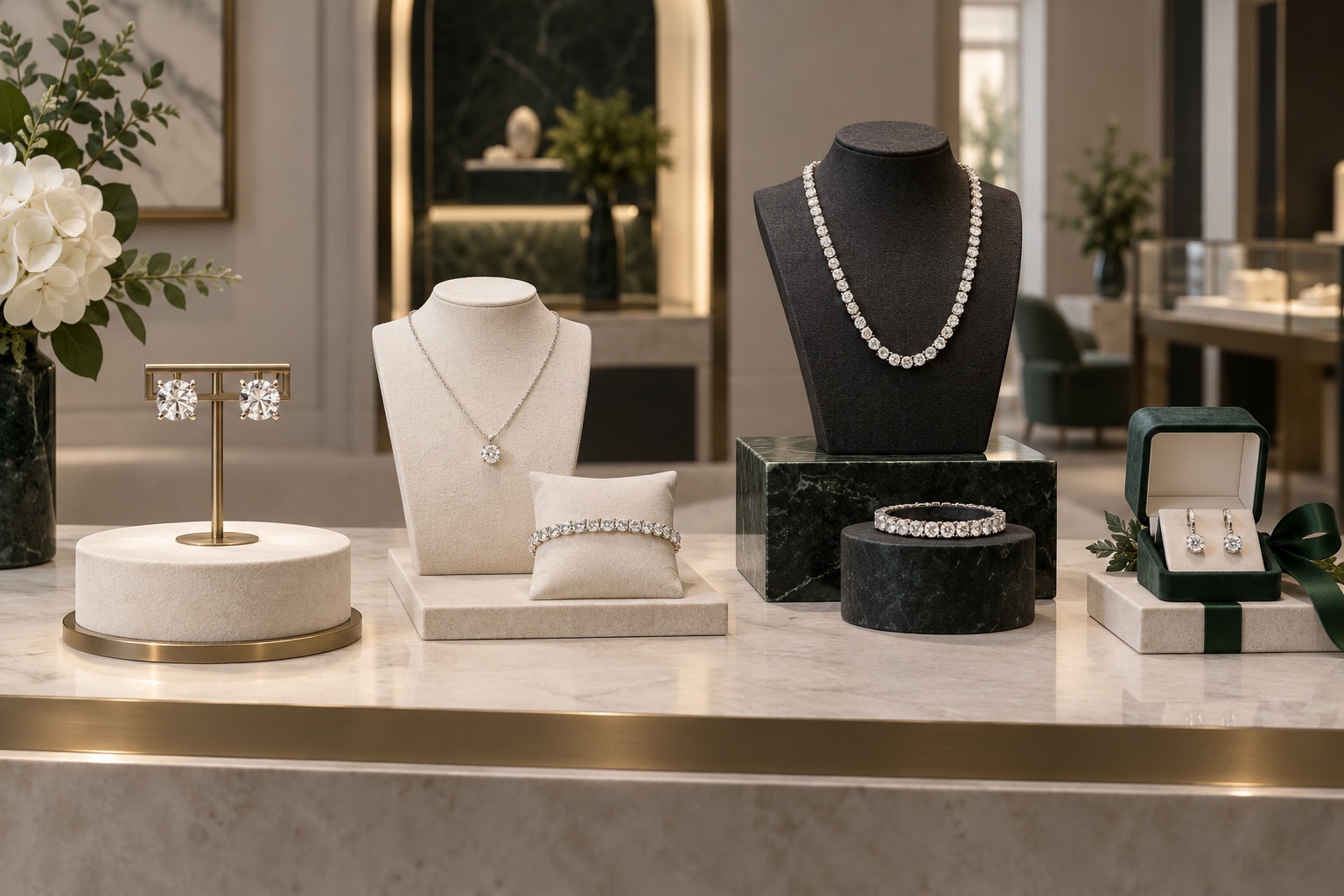
Discount a clearly defined group rather than the entire catalog. This works when the retailer wants to focus demand on styles with dependable inventory and known economics.
Spend-threshold offer
Provide a benefit only after the basket reaches a target amount. This can support average order value, but the threshold must reflect the store’s normal basket size and margin structure.
Curated gift set
Present complementary pieces together with one clear value proposition. If you already created seasonal combinations, use the framework in our Holiday Jewelry Gift Bundles guide to review price tiers, packaging and replenishment risk.
Gift-with-purchase
Use an approved, cost-controlled item to add perceived value without reducing the ticket price of the hero product. Confirm supply before promising the gift and define what happens if it runs out.
Early-access offer
Give existing customers or email subscribers a limited head start. Early access can spread fulfillment volume and reward loyalty without changing the public offer.
Do not stack multiple mechanisms unless the checkout, staff and customer-service team can explain them in one sentence.
4. Assign products by role, not only by category
A balanced campaign usually needs four product roles:
- Traffic driver: a recognizable giftable style that earns attention.
- Basket builder: an item that naturally complements the traffic driver.
- Margin protector: a differentiated piece that remains at full price or receives a smaller benefit.
- Premium anchor: a higher-value option that makes the assortment feel complete.
For example, a retailer might use approachable moissanite earrings as giftable traffic drivers, pair them with selected moissanite necklaces, retain premium tennis necklaces as anchors and keep selected metal-heavy pieces outside the deepest offer.
These are merchandising roles, not automatic discount recommendations. The retailer must approve eligibility using current product cost, stock and price data.
5. Confirm inventory at the variant level
Do not rely only on the total quantity for a product family. Review the variants customers actually choose:
- Ring sizes.
- Chain lengths and widths.
- Metal color or plating color.
- Bracelet lengths.
- Earring and pendant configurations.
- Packaging components.
Set a promotional allocation for each included variant and define a stop rule. When the allocation is exhausted, either end the offer for that variant, show a truthful lead time or substitute only with the customer’s agreement.
Retailers preparing product pages should also use the Jewelry Product Listing Checklist for Holiday 2026 to confirm material, dimensions, care information, fulfillment expectations and accurate imagery before paid traffic arrives.
6. Publish one source of truth for promotional terms
Black Friday disputes often begin when an email, store sign and checkout show different rules. Prepare a single promotion brief that includes:
- Start and end times with time zone.
- Included and excluded products.
- Whether the offer may be combined with other discounts.
- Shipping thresholds and deadlines.
- Return and exchange treatment for promotional purchases.
- Gift-with-purchase limits and substitution policy.
- Contact method for help.
Copy the approved terms into every channel. Train store and customer-service teams with examples of eligible and ineligible baskets. Clear terms are good customer experience and also make the promotion easier for search engines and AI assistants to interpret.
7. Make the campaign page answer purchase questions
A useful campaign page should do more than announce a percentage. Add concise, indexable answers to the questions a shopper is likely to ask:
- What is included?
- When does the promotion begin and end?
- Does the offer apply automatically or require a code?
- Can it be combined with another offer?
- What are the shipping and return conditions?
- Which styles are suitable for gifts at different price points?
Use descriptive headings, accurate product names, visible terms and meaningful image alt text. Link to relevant product categories and avoid hiding essential conditions only inside an image. These practices support conventional SEO and improve the chance that answer engines can extract a reliable response.
8. Use a four-phase 2026 campaign calendar
For 2026, Thanksgiving falls on November 26, Black Friday on November 27 and Cyber Monday on November 30. A practical schedule is:
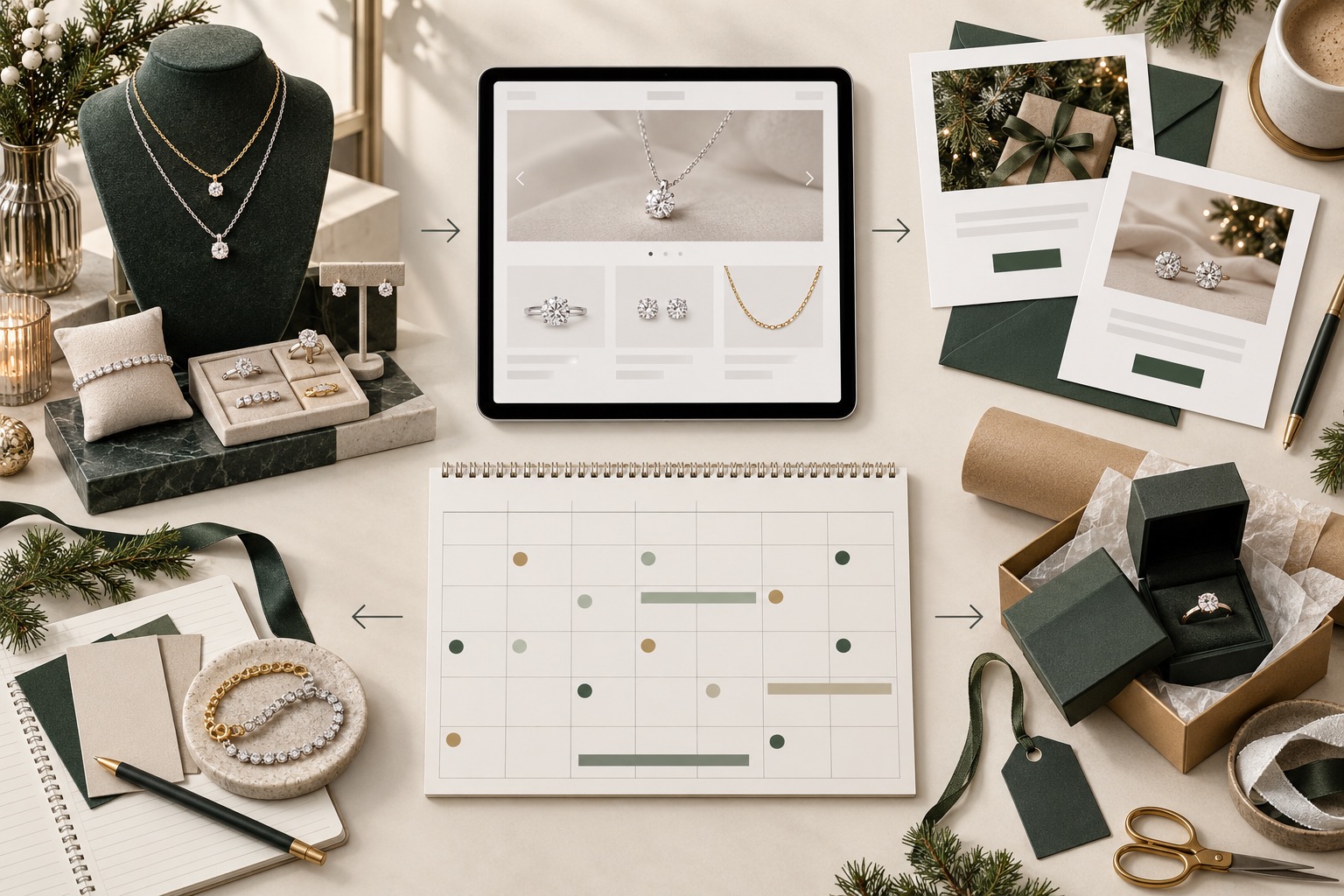
Phase 1: October 5–18 — economics and assortment
Approve objectives, SKU eligibility, margin floors, inventory allocations and replenishment contingencies.
Phase 2: October 19–November 1 — content and operations
Build landing pages, photography, email segments, store signage, paid-media creative and staff guidance. Test codes and exclusions.
Phase 3: November 2–22 — discovery and demand capture
Publish gift education, update product pages, collect early-access sign-ups and allow search engines time to crawl the campaign content.
Phase 4: November 23–30 — execution and monitoring
Monitor stock, margin, site performance, customer questions and fulfillment capacity daily. Keep Black Friday and Cyber Monday rules coordinated unless a deliberate change has been approved.
9. Measure incremental profit after the event
Gross revenue does not show whether the promotion worked. Review:
- Contribution dollars and contribution margin.
- New-customer acquisition cost.
- Average order value.
- Units per transaction.
- Full-price attachment rate.
- Return and cancellation rate.
- Sell-through by included SKU and variant.
- Email sign-ups and repeat purchases from the acquired cohort.
Compare results with a relevant baseline, not only the previous day. Document which offer, product role and channel produced profitable orders so the next campaign begins with evidence.
Plan your wholesale assortment before promotion approval
LEKANI JEWELRY supplies jewelry retailers, boutiques, bridal stores, online sellers, distributors and resellers worldwide. Explore verified categories such as moissanite bracelets, moissanite necklaces and tennis necklaces, then review the wholesale FAQ before building your campaign assortment.
Ready to source for your holiday plan? Apply for a wholesale account and evaluate products against your own margin floor, target customer and promotional calendar.
Frequently asked questions
When should jewelry retailers start planning Black Friday promotions?
Begin six to eight weeks before Black Friday. That window supports SKU-level margin review, inventory allocation, photography, page creation, staff training, email segmentation and search indexing.
Should a jewelry retailer run a sitewide Black Friday discount?
Not automatically. A selective offer is often easier to control because product costs, stock depth and replacement risk differ across jewelry categories and variants. Approve participation at the SKU level.
How can a jewelry store protect margin during Black Friday?
Calculate contribution after product cost, payment fees, fulfillment, promotional subsidies and expected returns. Establish a minimum margin, exclude SKUs below that floor and use thresholds or curated sets when they better fit the economics.
What products work well in a holiday jewelry promotion?
Giftable, easy-to-understand products with sufficient inventory and clear product information are strong candidates. The final decision should reflect the retailer’s customer, price architecture, stock by variant and actual contribution margin.
How should Black Friday and Cyber Monday jewelry offers differ?
They may use the same structure for clarity, or Cyber Monday may emphasize online-only discovery and follow-up. If terms change, state the new dates, eligibility and redemption rules clearly across every channel.


