
How to Evaluate a Wholesale Jewelry Supplier Before Your First Order
Use a practical supplier-evaluation checklist to compare product facts, samples, ordering terms, fulfillment and reorder support before committing inventory.

Choosing a wholesale jewelry supplier is an inventory decision, not simply a price comparison. A useful review checks whether the supplier can help you identify the exact item, place a controlled first order and reorder the same variant later. Use the steps below before committing shelf space or advertising a design.

1. Start with product identity and material facts
Ask whether every sellable option has a stable product reference or SKU. The title, option labels, images and specifications should agree on material, stone, finish, size and selling unit. For earrings, confirm whether the price represents a pair or a single piece. For rings, confirm the available sizes. Do not treat a similar photo or title as proof that two variants are interchangeable.
2. Check image-to-variant consistency
Review the main image, gallery and option-specific images together. A supplier should make it possible to connect the chosen finish, size or design with the correct item. If a sample is used, record its exact reference instead of relying on memory. Generated or edited visuals may be useful for explaining a concept, but they should not be presented as documentary product photography.
3. Test the ordering rules with a small, deliberate assortment
Before building a large collection, calculate the merchandise minimum, price tier and quantity rule at SKU level. Ask whether styles may be mixed and whether quantity discounts are calculated across a category or separately for each SKU. The first order requires US$99 in merchandise per warehouse after discounts, excluding shipping and taxes. Eligible styles may be mixed within the same warehouse; returning customers have no minimum order value. Eligible styles may be mixed to reach the minimum, while quantity discounts apply per SKU.
4. Separate processing time from carrier transit
Confirm where the item is fulfilled and when it is expected to be ready for the carrier. Processing time and shipping transit are different parts of the timeline. LEKANI international orders normally process in 2–3 business days; carrier transit is additional. Check current availability and the delivery destination before promising a customer date.
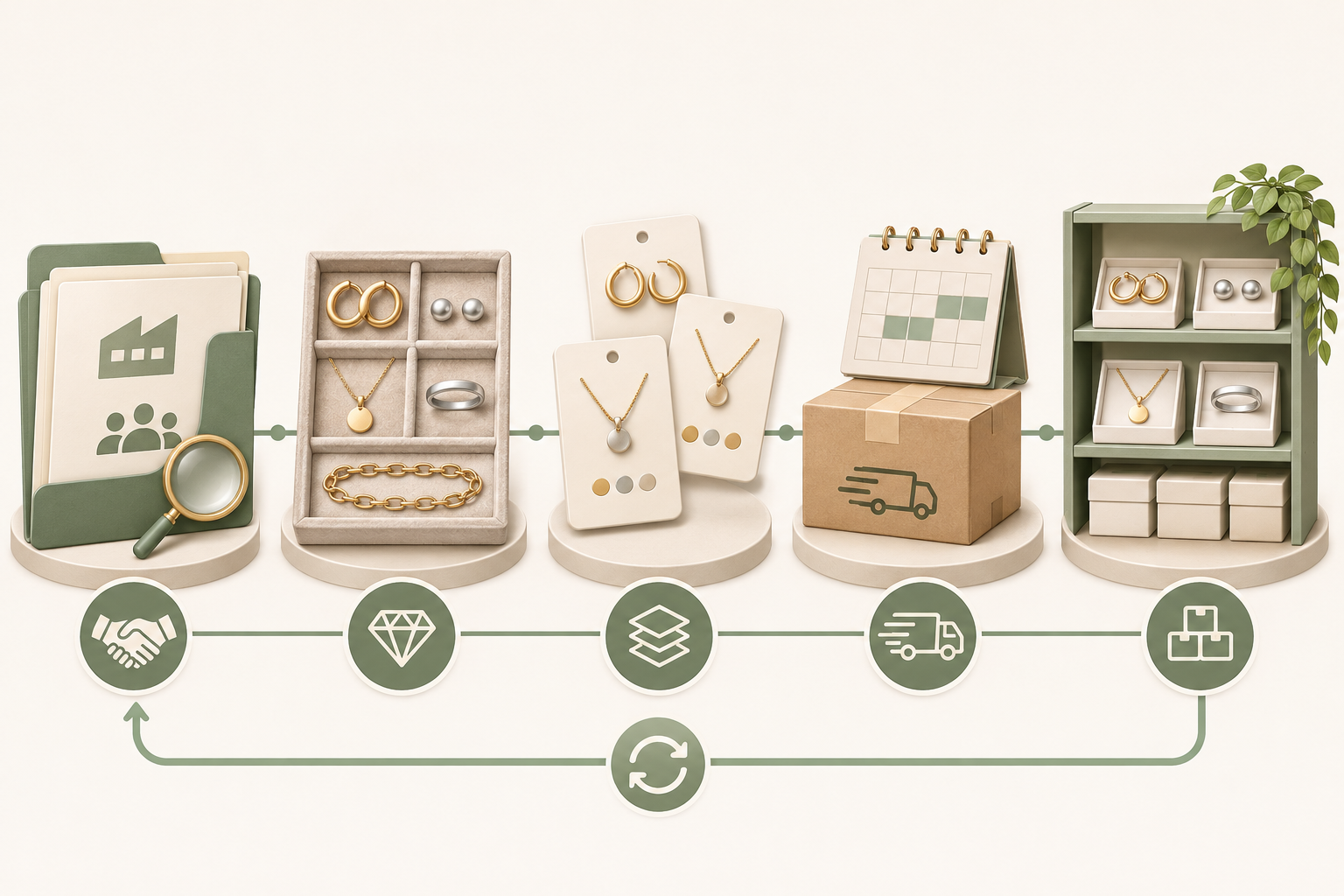
5. Plan the reorder before placing the first order
Save the exact SKU, size, finish and quantity for every selected item. Check whether the supplier maintains a clear account order history and whether product pages remain available for later reference. A good first order produces a usable sales test: each design can be traced to its source, evaluated by sell-through and replenished without guessing.
A five-point supplier scorecard
- Product clarity: exact materials, options, selling unit and images agree.
- Sample accuracy: each sample maps to a current product reference.
- Commercial fit: minimums, tiers and SKU rules match your test budget.
- Fulfillment clarity: processing and carrier transit are stated separately.
- Reorder continuity: selected variants can be identified again.


