
Holiday Jewelry Assortment Planning: A Retail Merchandising Checklist
A practical holiday jewelry assortment planning checklist for U.S. retailers, covering gift missions, good-better-best tiers, AI-ready product data, merchandising, and wholesale buying checkpoints.
Quick answer: Holiday jewelry assortment planning works best when a retailer gives every item a clear job. Build an accessible entry tier, a dependable core-gift tier, an upgrade tier, a small premium anchor, and a few easy add-ons. Then organize the same merchandise by gift recipient, occasion, metal, dimensions, and price position so shoppers—and AI shopping tools—can compare it without guessing.
For U.S. jewelers, boutiques, bridal stores, online retailers, distributors, and resellers, early September is the time to turn a broad jewelry catalog into a focused holiday offer. The objective is not to place every available SKU into a holiday collection. It is to create a limited number of understandable choices that cover distinct budgets and gift missions while preserving enough flexibility to reorder proven styles.
Why Holiday Jewelry Assortment Planning Needs to Start Now
Holiday discovery begins well before Black Friday. In its August 2026 U.S. consumer research, McKinsey & Company reported that 45% of surveyed consumers expected to have started holiday shopping by the end of October. It also found that 46% would probably or definitely use AI tools for holiday shopping, especially to compare products and prices, find deals, and generate gift ideas.
That changes the retailer’s deadline. Merchandise, product data, photography, gift-guide copy, and store displays need to be ready while customers are still forming a consideration set—not only when promotional emails begin. A September 2026 JCK holiday-readiness article likewise emphasizes early inspiration, targeted marketing, storytelling, and curated collections rather than waiting to introduce holiday offers in November.
If you need the larger timing framework first, use LEKANI’s 2026–2027 wholesale jewelry holiday planning calendar. This guide focuses on the next decision: how to build the assortment customers will actually understand.
Start With Gift Missions, Not Product Categories
A product category describes what an item is. A gift mission explains why a customer is shopping. Organizing around both creates stronger merchandising and more useful search content.
Begin with five common missions:
- Accessible gift: A polished, lower-commitment choice for coworkers, friends, bridal parties, or first-time fine-jewelry customers.
- Core relationship gift: A recognizable piece with broad appeal for a partner, spouse, or close family member.
- Milestone or upgrade gift: A more substantial item for an anniversary, engagement-related occasion, major birthday, or personal achievement.
- Statement or premium gift: A visually important piece that anchors the display and establishes the upper end of the assortment.
- Add-on or companion gift: A smaller item that completes a look or increases the usefulness of a primary purchase.
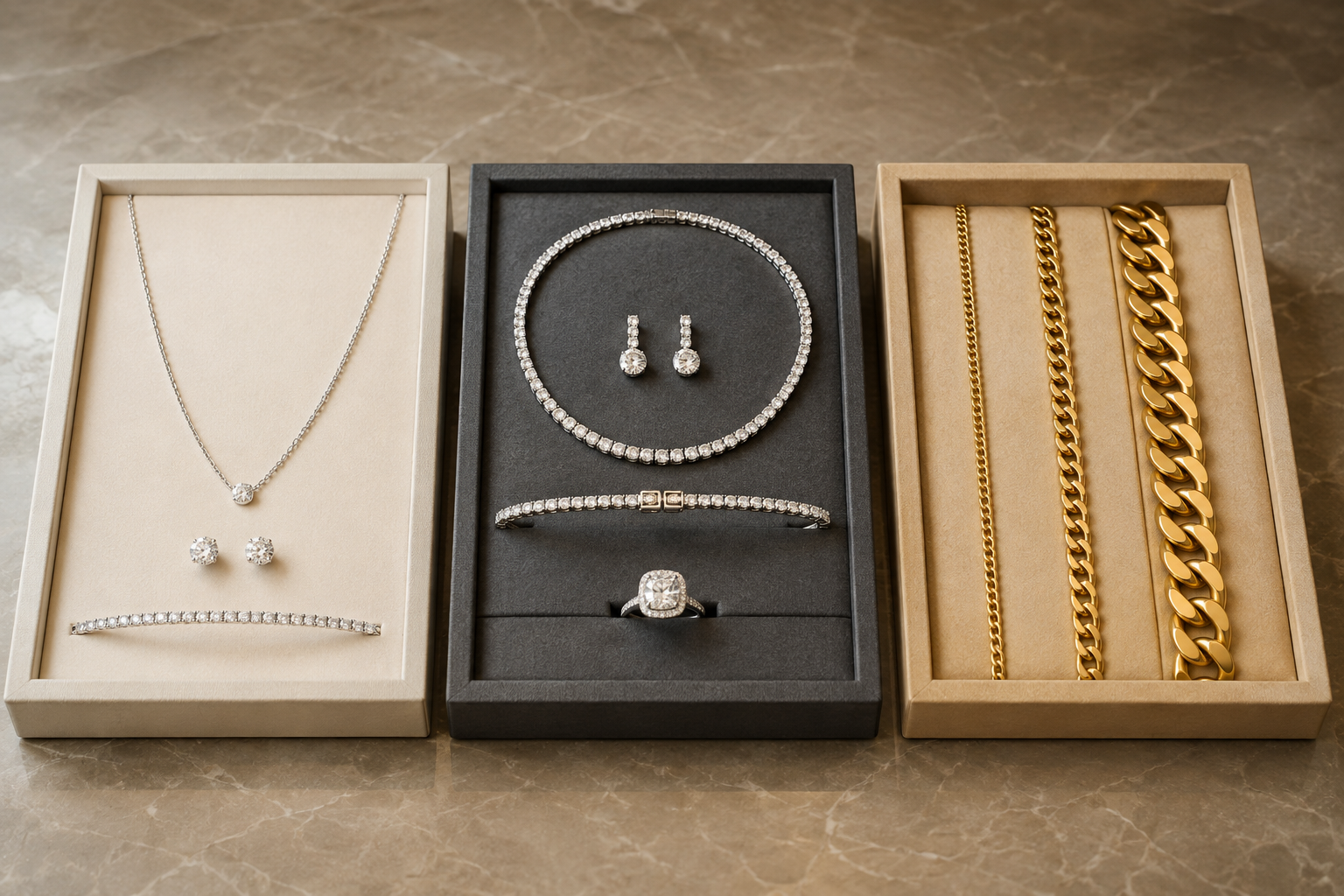
One product can serve more than one mission, but the collection page and display should assign it a primary role. A narrow moissanite tennis bracelet might be an accessible introduction to the category, while a wider bracelet may operate as the statement comparison. A 925 silver chain can be a practical standalone gift or a companion for a pendant. Moissanite studs can work as an entry gift, bridal-party option, or add-on to a necklace.
Build a Good-Better-Best Assortment Without Forcing Fixed Price Points
“Good, better, best” is a comparison structure, not a universal price list. Each retailer should define the bands according to its customer base, average order value, channel, and margin requirements. The important part is that customers can see why one option differs from the next.
| Assortment role | Possible wholesale categories | Customer-facing comparison | Buying approach |
|---|---|---|---|
| Accessible entry | 925 silver chains, moissanite studs, smaller rings, pendants, narrow tennis bracelets | Easy gifting, wearable scale, clear material value | Use focused breadth and testable depth across proven variations |
| Core gift | Classic tennis bracelets, tennis necklaces, versatile chain lengths, moissanite earrings | Recognizable silhouette, broad appeal, straightforward specifications | Protect availability on the strongest widths, lengths, colors, and sizes |
| Upgrade | Wider tennis profiles, longer necklaces, 10K or 14K gold chains, coordinated sets | More presence, higher material commitment, milestone positioning | Stock selectively; support the difference with photography and specification detail |
| Premium anchor | Statement tennis jewelry and selected 14K or 18K gold chains | Luxury material, scale, craftsmanship, or design importance | Keep the edit tight and review each SKU individually |
| Add-on | Studs, simple earrings, companion chains, stacking rings, matching bracelets | Completes a set or solves a second gift need | Place near the primary item online and in the case |
A price ladder is only credible when the merchandise explains it. Use exact metal, stone, size, construction, finish, and clasp information to show the difference. Avoid creating multiple tiers from visually interchangeable items with no clear reason for the price change.
Use Material and Product Type to Create a Balanced Value Ladder
The 2026 jewelry market remains divided. JCK’s August analysis of the industry’s “K-shaped” market described higher jewelry sales alongside lower unit volume and a higher average purchase price, while also noting continued pressure on value-conscious shoppers. For an independent retailer, that argues for a visible ladder rather than an assortment concentrated at only one end.
925 sterling silver and silver moissanite
Sterling silver chains and 925 silver moissanite rings, earrings, studs, bracelets, and necklaces can support accessible gifting and broader style coverage. Retail copy should clearly state the base metal, finish or plating where applicable, stone description, dimensions, and care expectations. Do not let “silver,” “silver tone,” and “sterling silver” become interchangeable language.
Tennis bracelets and tennis necklaces
Tennis jewelry can span multiple tiers through width, length, setting scale, finish, and overall construction. Keep the number of comparison points manageable. A narrow, medium, and statement profile usually tells a clearer story than several nearly identical options competing for the same customer.
10K, 14K, and 18K gold chains
Solid-gold chain options can serve upgrade and premium roles, but karat alone should not be the only comparison. Record the construction, length, width, clasp, approximate weight when supplied, and whether the item is intended for a pendant or standalone wear. Because precious-metal prices can move, confirm current product information and costs before building promotional claims.
Create Three Coordinated Holiday Capsules
A capsule is a small group of products that can be photographed, displayed, emailed, and discussed together. It converts a large assortment into a story that a customer can process quickly.
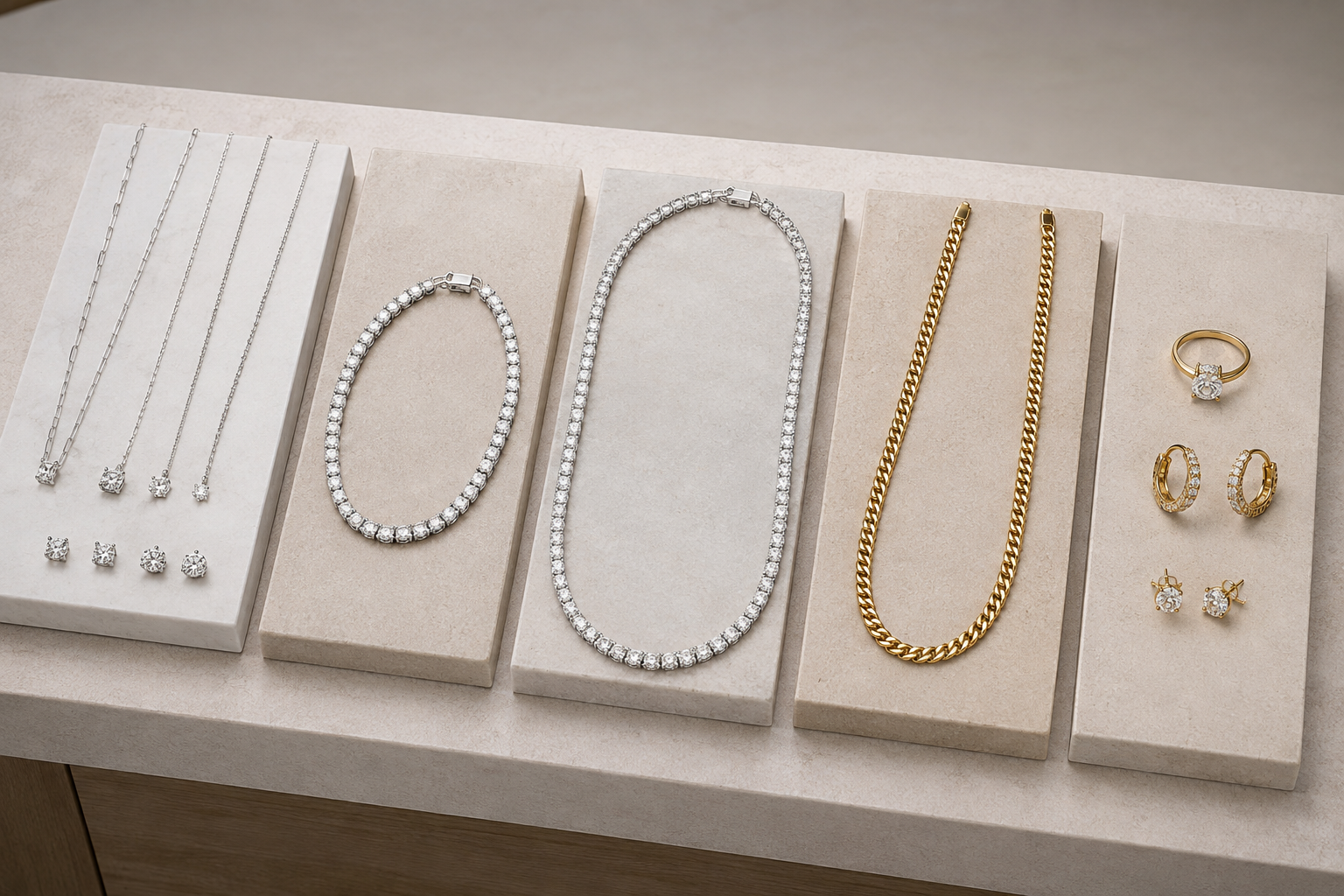
- Everyday Brilliance: Refined moissanite studs, a narrow tennis bracelet, a simple sterling silver chain, and a small ring or pendant. Position around daily wear, first-time gifting, and easy coordination.
- Celebration Sparkle: A core tennis bracelet, tennis necklace, moissanite earrings, and one statement ring. Position around anniversaries, holiday events, bridal occasions, and milestone gifts.
- Gold Upgrade: Selected 10K, 14K, or 18K chains with clear length, width, construction, and styling comparisons. Position around lasting material value and a deliberate upgrade.
These are merchandising frameworks, not prepacked product promises. Build each capsule from current sellable inventory, accurate specifications, and styles that fit the retailer’s customer.
Make Product Data Ready for Search and AI Comparison
Holiday shoppers increasingly use AI during discovery and comparison. Google’s August 2026 holiday marketing guidance describes conversational search as an expanding part of product discovery and recommends rich product data as a foundation for the season. McKinsey similarly found that likely AI users expected to use these tools most often for product and price comparison, deal finding, and gift ideas.
For jewelry, a useful product page should answer the questions a customer—or an AI system summarizing choices—would need:
- What is the exact product type?
- What is the declared base metal and metal purity?
- Is there plating or another surface finish?
- Is the stone natural, laboratory-created, simulated, or imitation, and how is it described by the supplier?
- What are the finished length, width, dimensions, and available variants?
- What clasp, setting, or construction details affect wear and use?
- What is included in the purchase?
- What are the current availability, processing, shipping, return, and care terms?
The FTC Jewelry Guides emphasize truthful representation of precious-metal content, gemstones, treatments, dimensions, value, and other product characteristics. Retailers should keep the same accurate terminology across supplier records, product pages, gift guides, ads, packaging, and staff talking points.
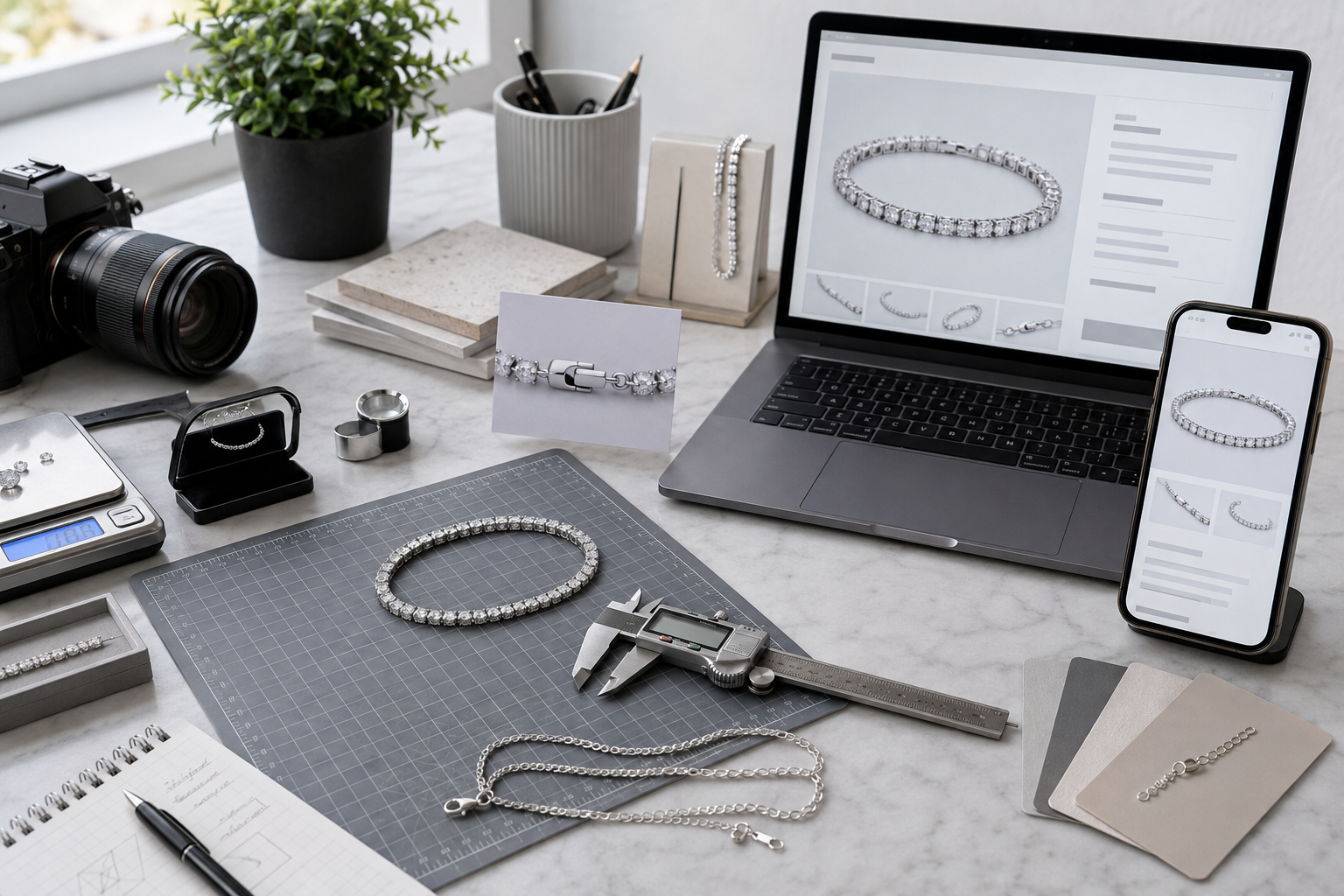
Use descriptive page titles and headings, concise comparison tables, meaningful image Alt text, and short FAQ answers. These elements help conventional search engines understand the page and make the information easier for AI tools to extract and summarize.
Merchandise the Same Comparison Online and In Store
A customer should recognize the same assortment logic whether they enter through a display case, collection page, email, social post, or AI-generated recommendation.
In the store
- Place three meaningful comparison options together instead of separating them by supplier.
- Label metal, width, length, and stone type accurately on every ticket.
- Use one premium anchor to frame the range without overcrowding the case.
- Keep add-on pieces close to the hero gift they complement.
- Prepare a short staff explanation for why each tier exists.
Online
- Create gift collections by recipient, budget band, occasion, and product type.
- Use consistent image sequences: clean primary view, worn scale, side profile, clasp or setting close-up, and packaging where applicable.
- Build comparison links between related widths, lengths, metals, and price positions.
- Add complementary products deliberately rather than showing unrelated recommendations.
- Keep prices, inventory messages, and shipping expectations synchronized across channels.
Use September and October as a Test-and-Learn Window
Pinterest’s 2026 festive planning guidance reports that holiday activity on its platform can rise as early as September and recommends using earlier moments, including Halloween, to test creative before the main Q4 push. Retailers can use the same principle without turning every message into a discount.
Test one variable at a time:
- recipient-led versus product-led gift-guide headlines;
- single-product photography versus coordinated capsule photography;
- metal-focused comparisons versus occasion-focused comparisons;
- educational content versus direct promotional content;
- accessible-entry products versus upgrade products as the collection hero.
Track product-page visits, email clicks, saves, inquiries, add-to-cart activity, completed sales, and requests for unavailable variations. A small test is useful only when the team records what changed and what happened.
A Six-Week Holiday Assortment Workback Plan
| Week | Primary task | Required output |
|---|---|---|
| September 7 | Define gift missions and good-better-best roles | Approved SKU-role matrix |
| September 14 | Audit product data and variant accuracy | Corrected specifications and missing-data list |
| September 21 | Photograph capsules and comparison views | Store, ecommerce, email, and social image set |
| September 28 | Launch early gift-guide and creative tests | Baseline results by audience and product tier |
| October 5 | Finalize promotions, bundles, and staff language | Channel calendar and approved offer rules |
| October 12 | Review gaps, reorder decisions, and holiday-event readiness | Final exception list before late-October demand |
The October 12 checkpoint also falls immediately before JIS Fall, scheduled for October 16–19, 2026. Whether or not a retailer attends, the event is a useful industry deadline for identifying holiday assortment gaps and documenting supplier questions.
Connect Assortment Planning to Reorder Discipline
An assortment plan decides which roles the retailer wants to cover. A reorder plan decides which specific SKUs deserve more inventory. Keep those decisions separate.
Use LEKANI’s jewelry inventory reorder planning guide to review sell-through, weeks of supply, lead time, safety stock, and SKU roles. Do not deepen an item merely because it appears in the holiday campaign. Replenish when sales evidence, remaining supply, timing, and the item’s role support the decision.
Wholesale Questions to Resolve Before the Holiday Push
- Which styles and variants are currently available for wholesale ordering?
- Which products are intended to remain replenishable through the season?
- What are the current processing, transit, receiving, and inspection expectations?
- Which specifications define each SKU: metal, purity, finish, stone, dimensions, length, width, weight, setting, and clasp?
- Can eligible categories, styles, and variants be mixed within an order?
- What are the current opening-order and reorder requirements?
- What product images and data are authorized for approved wholesale customers?
- How should discrepancies, defects, returns, or RMA requests be reported?
LEKANI serves jewelry businesses worldwide, with products fulfilled from the U.S. or China warehouse shown on each product page. Review the current Wholesale FAQ for account approval, ordering, shipping, and RMA information. Product availability and terms can vary, so verify the current product page or contact the wholesale team before making a customer-facing commitment.
Frequently Asked Questions
What is holiday jewelry assortment planning?
Holiday jewelry assortment planning is the process of selecting and organizing products for seasonal gift demand. It assigns each SKU a customer, occasion, price position, merchandising role, and inventory approach so the collection is easier to shop and manage.
When should jewelry retailers prepare holiday assortments?
Preparation should begin early enough to complete sourcing, receiving, inspection, photography, product-page updates, staff training, and creative testing before customers start comparing gifts. In 2026, research indicates that many U.S. consumers plan to begin shopping during September and October rather than waiting for Black Friday.
What jewelry works in a good-better-best assortment?
The structure can include accessible 925 silver and moissanite pieces, core tennis bracelets or necklaces, upgrade options with more scale or precious-metal commitment, selected 10K/14K/18K gold chains, a small premium anchor, and related add-ons. The exact products should reflect the retailer’s customer and current inventory.
How many holiday jewelry SKUs should a retailer carry?
There is no universal number. Use the smallest assortment that covers the required gift missions, price positions, product categories, and important variants without creating confusing duplication. Expand only when sales or customer requests show a clear gap.
How can a jewelry product page become more useful for AI shopping tools?
Use a precise product title, complete material and stone descriptions, dimensions, variant data, clasp or setting details, current availability, consistent pricing, descriptive images, meaningful Alt text, comparison information, and concise FAQs. Keep those facts consistent across every channel.
Should holiday promotions determine wholesale buying quantities?
No. A promotion can affect expected demand, but buying quantities should also reflect recent sales, weeks of supply, lead time, safety stock, margins, return behavior, and the SKU’s role. Test items and premium anchors generally require a different depth strategy from proven core products.
Build a Holiday Collection Customers Can Understand
A productive holiday assortment does not ask the customer to decode the jewelry case. It presents clear gift missions, meaningful comparison points, accurate product data, and a controlled path from accessible entry to premium upgrade. Build the structure in September, test it in October, and use sales evidence to decide what deserves deeper inventory.
Ready to review a holiday wholesale assortment? Browse LEKANI’s wholesale tennis bracelets and wholesale tennis necklaces, or apply for a wholesale account to discuss current options for your jewelry business.
Sources and further reading: McKinsey, 2026 U.S. holiday consumer research; Google, 2026 AI-powered holiday marketing guidance; JCK, 2026 holiday readiness; Pinterest Business, 2026 festive planning guide; Federal Trade Commission Jewelry Guides.


