
Wholesale Moissanite Rings Buying Guide for Jewelry Retailers
Build a productive wholesale moissanite ring assortment by comparing stone dimensions, settings, ring-size depth, 925 silver finish, matching-band fit, inspection, and reorder consistency.
Wholesale moissanite rings can help jewelers, bridal stores, boutiques, and online retailers add a high-sparkle ring category without building an opening assortment around a single customer profile. The opportunity is strongest when each SKU has a defined retail role and complete specifications—not when every ring is presented as an interchangeable “diamond alternative.”
For U.S. wholesale buyers, a productive ring program requires more than choosing shapes and stone sizes. Buyers should compare gemstone identity, millimeter dimensions, setting construction, ring-size depth, 925 sterling silver and surface finish, finished weight, matching-band compatibility, packaging, inspection standards, and reorder consistency before committing inventory.
Quick buying answer
- Start: one classic solitaire or low-profile style with verified specifications and a practical size run.
- Build: add a second stone shape or halo design only when it serves a different customer or price role.
- Protect margin: buy ring-size depth according to sales history instead of ordering every size equally.
- Prepare for engagement season: complete product data, photography, packaging, and staff training before holiday proposal demand begins.
Why Moissanite Rings Deserve a Separate Wholesale Buying Plan
Rings introduce inventory decisions that earrings, bracelets, and necklaces do not. Every design can require multiple sizes, and a style that looks productive at the SKU level may become slow-moving when its units are spread across too many size variants. Bridal and engagement-focused rings also carry higher expectations for fit, setting security, product disclosure, presentation, and after-sale communication.
Current wedding-jewelry reporting supports a focused alternative-ring strategy. JCK’s 2026 coverage describes alternative and personalized engagement rings as a lasting retail opportunity, while The Knot’s Real Weddings Study 2026 identified moissanite among the leading non-diamond center-stone choices. That does not mean every store needs a broad moissanite program. It means retailers should build a clear, well-documented assortment for the customers they actually serve.
What Should a Wholesale Buyer Verify First?
Begin with the product specification, not the promotional title. “Moissanite ring” should identify the center and accent stones accurately and describe the base metal, finish, dimensions, setting, and ring size separately. Moissanite is a distinct gemstone and should not be represented as a natural diamond or laboratory-grown diamond.
Request these fields for every ring SKU:
- Center-stone identity, shape, cut style, millimeter dimensions, and quantity
- Accent-stone identity, dimensions, and quantity where applicable
- Actual stone weight when supplied, separated from any comparison or equivalent weight
- Verified base metal and any rhodium, gold-tone, rose-gold-tone, or other surface finish
- Setting style, prong count, basket or gallery construction, and setting height
- Band width, band thickness, shoulder construction, and finished ring weight
- Available ring sizes, sizing tolerance, and whether the design can be resized
- Matching-band compatibility, gap, profile, and sold-separately information
- Inspection, packaging, reorder, and replacement-component policies
The Federal Trade Commission’s Jewelry Guides emphasize truthful descriptions of gemstones and precious metals. The FTC also warns that some basic thermal diamond testers can register moissanite as diamond, so a positive thermal test alone is not sufficient to identify or market a stone as diamond.
Build the Opening Assortment by Retail Role
A concise assortment is easier to merchandise, explain, photograph, and replenish than a wide group of overlapping designs. Assign each style a job before buying size depth.
| Assortment role | Useful starting style | What to verify |
|---|---|---|
| Core | Classic round or oval solitaire | Center dimensions, setting height, prong alignment, size run |
| Accessible | Smaller center profile or refined band | Visible scale, finished weight, finish, packaging |
| Trade-up | Larger center, halo, or more substantial setting | Center and accent identity, total dimensions, balance |
| Personalized | Elongated shape, east-west setting, or distinctive shoulder | Orientation, symmetry, stone security, reorder consistency |
| Bridal set | Engagement-style ring with coordinating band | Fit, gap, profile, size matching, separate SKU details |
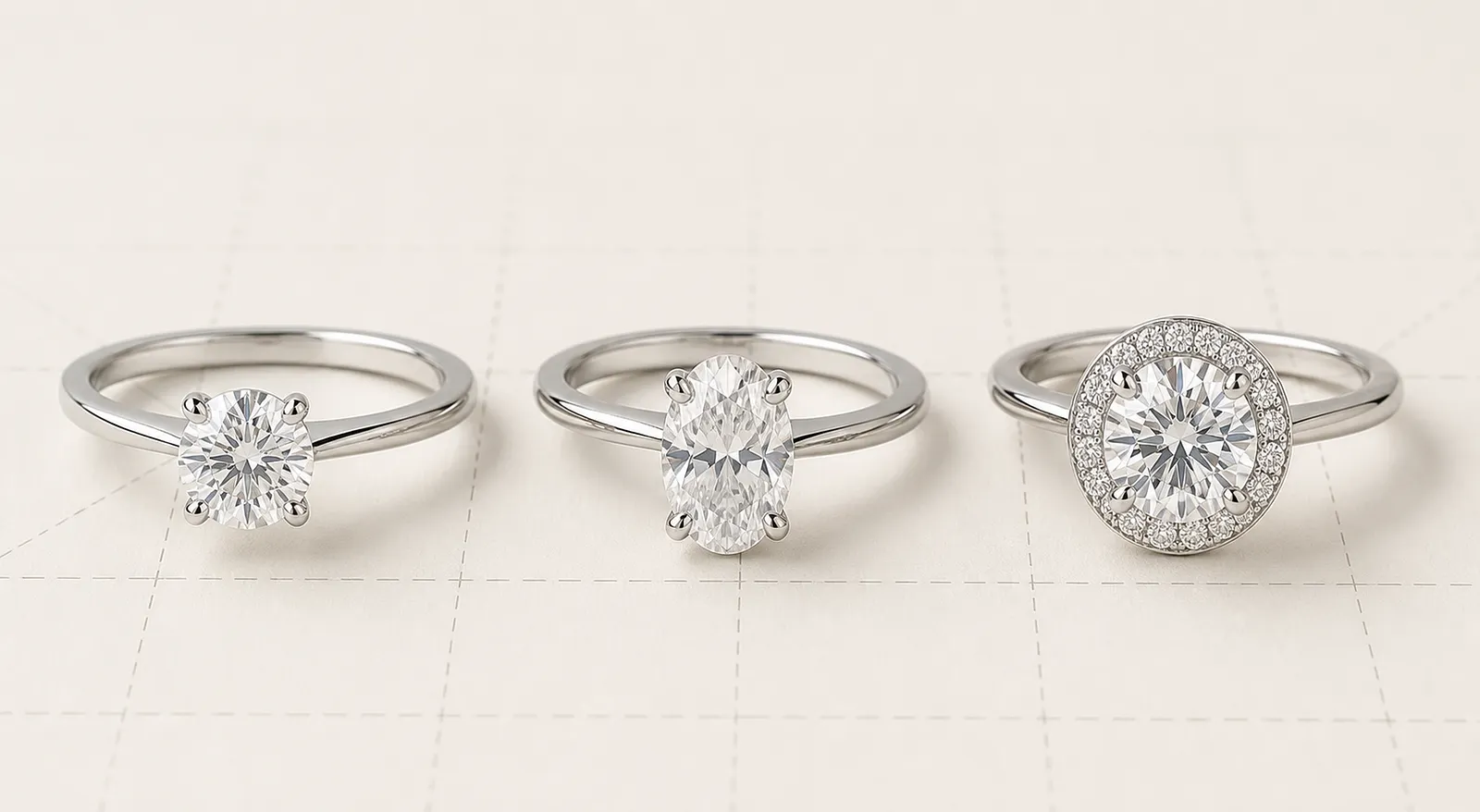
Use a classic solitaire as the comparison anchor. A halo, elongated center, or distinctive band should create a visible reason to trade up rather than duplicate the same retail role. If a design is trend-led, test it with narrower size depth until customer requests and sell-through justify replenishment.
Compare Stone Size in Millimeters, Not Marketing Terms Alone
Millimeter dimensions give buyers and customers a direct visual reference. List the length and width for elongated shapes and the diameter for round stones. If a supplier also provides a diamond-equivalent or comparison weight, label it clearly and do not substitute it for the stone’s actual identity, dimensions, or supplied weight.
For a ring assortment, compare each center stone at the same photography scale and angle. A 6.5 mm round, an elongated oval, and a cushion of similar stated comparison weight can have different face-up dimensions, coverage, and visual balance. Setting height and halo width can also change the perceived size.
- Record center-stone length, width, and depth where supplied.
- Separate center-stone measurements from total ring dimensions.
- Photograph multiple sizes against the same neutral reference.
- Avoid unsupported grade, origin, sustainability, or certification claims.
- State exactly what any report or card covers.
Inspect the Setting from Every Angle
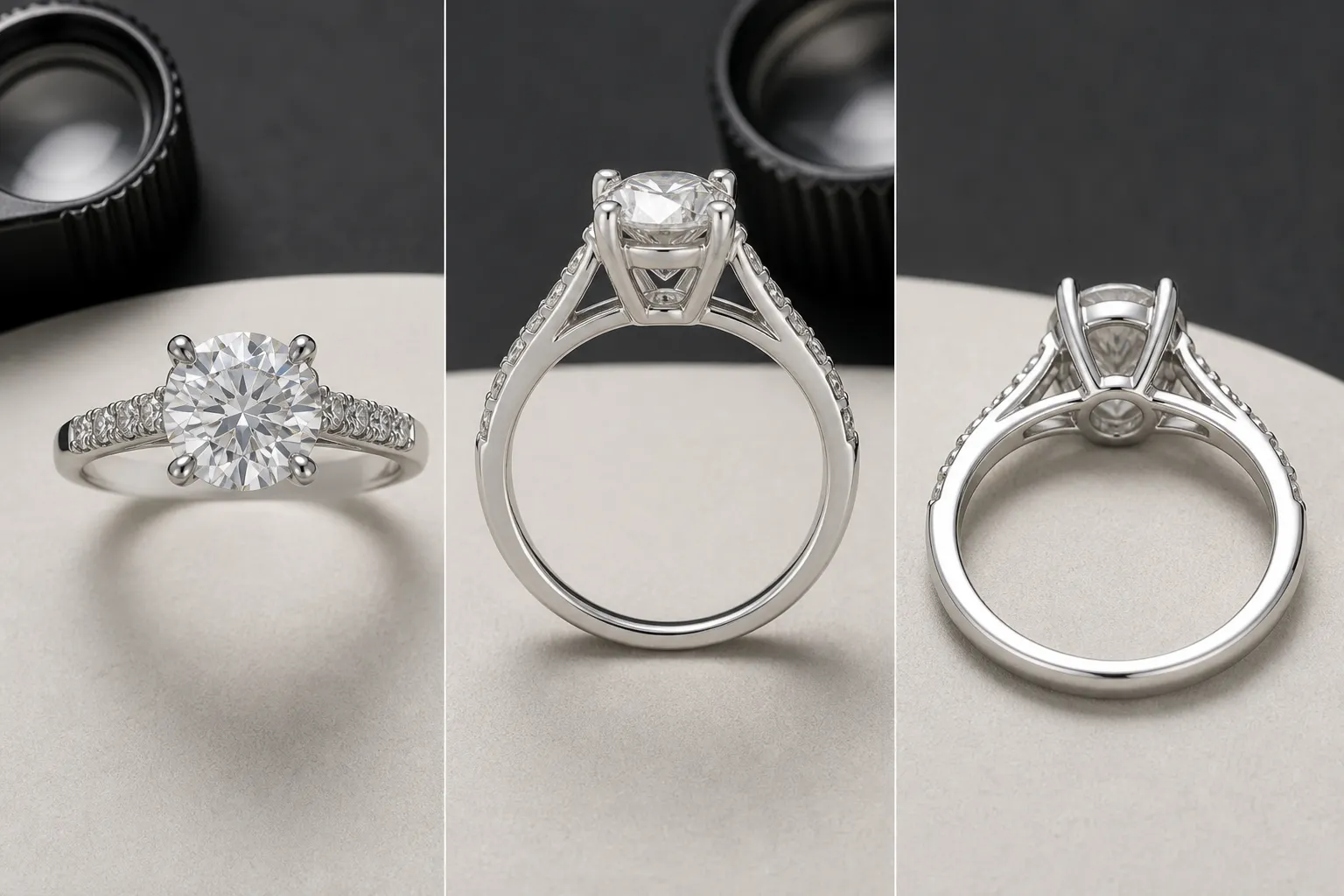
A ring may look aligned from the top while showing issues in profile. Inspect the center stone, prongs, basket, gallery, shoulders, shank, and inside finish under neutral lighting and magnification.
Prong and stone alignment
Confirm that each prong contacts the stone, the tips are smooth and consistent, and the center stone is level. Compare spacing from the top and profile. For elongated stones, check orientation and end-prong protection where applicable.
Basket and gallery construction
Review the setting height, under-gallery access, soldered joints, and clearance above the finger. A lower profile may improve everyday wear, while a taller profile can change visibility and matching-band fit. Neither is automatically better; the product page should show the difference.
Band and shoulder consistency
Measure band width and thickness at defined points. Inspect shoulders for symmetry, accent-stone alignment, and clean transitions into the shank. Thin or open designs require especially clear handling and resizing guidance.
Plan Ring-Size Depth Before Ordering Units
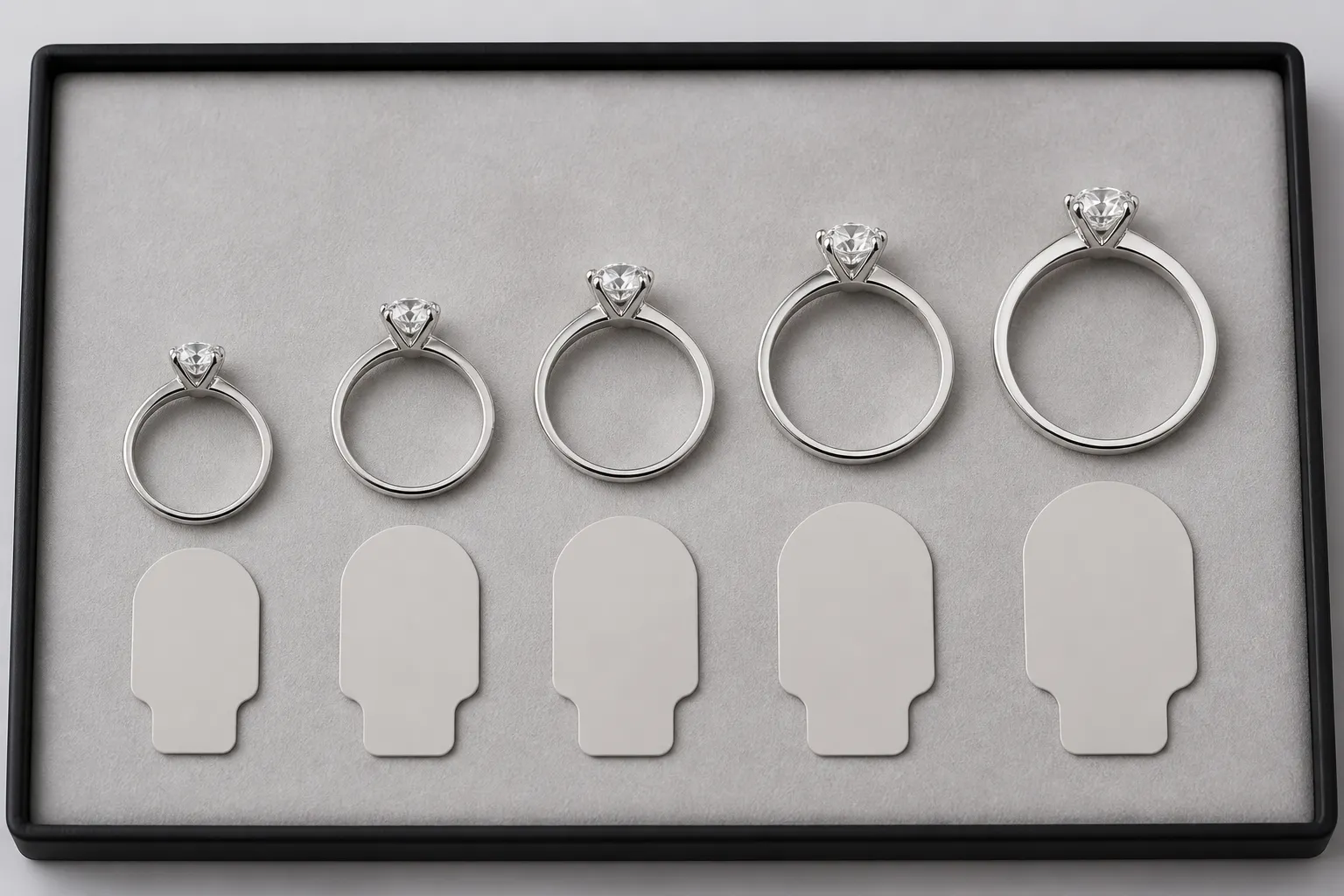
Ring size is the main inventory multiplier. Do not divide the opening buy equally across every available size unless sales history supports that decision. Start with the sizes your store sells most often, then use controlled depth above and below the core range.
A practical size plan should define:
- Core sizes that receive the deepest unit count
- Adjacent sizes carried in smaller quantities
- Extended sizes available by reorder or special request
- Supplier sizing tolerance and measurement method
- Whether the design can be resized without affecting stones or finish
- How matching bands are paired by size and profile
- How size exchanges and special orders are handled
Online retailers should publish a consistent sizing guide and confirm the selected size in order records. Bridal stores should also decide whether sample rings are for display only or represent immediately sellable inventory.
Document 925 Sterling Silver and Surface Finish Separately
For 925 silver moissanite rings, identify sterling silver as the base metal and record the surface treatment separately. White, yellow, and rose appearances may involve different plating systems. A plated color must not be described as solid gold.
Ask for finished ring weight, finish color, plating information, and care guidance. Avoid promises that silver will never tarnish or that plating will never change. If the ring contains components made from another material, document them separately instead of extending the 925 claim to the entire product without support.
Prepare Product Pages for Bridal and Engagement Questions
Complete product data supports search visibility, AI answer extraction, and customer confidence. It also gives sales staff a consistent way to explain the ring.
- Product title with verified gemstone and metal identity
- Center and accent-stone specifications
- Face-up dimensions, setting height, band width, and finished weight
- Available sizes, sizing tolerance, and resize guidance
- Front, side, back, gallery, and on-hand scale photography
- Matching-band fit and sold-separately status
- Packaging, care, inspection, and return-policy links
- Clear statement of what any certificate, report, or card covers
Use descriptive, factual language rather than unsupported superlatives. A product page that explains stone dimensions, setting profile, ring size, metal, finish, and care is more useful to both shoppers and search systems than a title built only around “luxury,” “best,” or “diamond-like.”
Work Backward from Fall Merchandising and Engagement Season
Engagement season generally runs from Thanksgiving through Valentine’s Day, with Christmas proposals remaining a major occasion. Retailers should work backward from that selling window. Late August and September are useful for confirming samples, size depth, product data, photography, packaging, staff training, and reorder terms; October can be used to launch discovery content and collect early customer preferences.
LEKANI’s wholesale jewelry holiday planning calendar provides a broader merchandising timeline. Buyers should also account for Labor Day on September 7 and the October 12 federal holiday as calendar checkpoints, but should base promotions on their own customer behavior rather than treating every holiday as an automatic jewelry event.
Use a Repeatable Receiving Inspection
- Confirm SKU, ring size, stone identity, base metal, finish, and quantity against the purchase record.
- Measure ring size with the same method used for listings and customer service.
- Inspect center and accent stones for alignment, security, and visible consistency.
- Review prongs, basket, gallery, shoulders, soldered joints, shank, and inside finish.
- Check band symmetry, setting height, and matching-band fit where applicable.
- Compare finish color and polish across units of the same SKU.
- Record defects and isolate affected pieces before photography or fulfillment.
- Retain an approved reference sample for future reorder comparison.
Questions to Ask a Wholesale Moissanite Ring Supplier
- Which stones in the design are moissanite, and what are their dimensions?
- What is the verified base metal, and what surface finish is applied?
- What ring sizes are available, and what sizing tolerance is used?
- Can the ring be resized, and what limitations apply?
- How are prongs, settings, and finished rings inspected?
- Are matching bands available, and how is fit verified?
- What finished weight and dimension fields are available?
- How are reorders kept consistent with the approved sample?
- What packaging, care information, and authorized product images are supplied?
- What do any certificate, report, or card specifically cover?
Frequently Asked Questions
What should retailers compare when buying wholesale moissanite rings?
Compare gemstone identity and millimeter dimensions, setting construction, ring-size availability, sizing tolerance, base metal, finish, finished weight, matching-band fit, inspection standards, packaging, and reorder consistency.
Are moissanite rings the same as diamond rings?
No. Moissanite is a different gemstone from natural and laboratory-grown diamond. Listings, staff scripts, labels, and receipts should identify it accurately.
What is a practical opening assortment?
Many retailers can begin with one classic core solitaire, one accessible option, and one clearly differentiated trade-up or personalized style. The exact mix and size depth should follow the store’s customer profile and sales history.
How should moissanite ring size be described online?
List the ring size separately from the stone’s millimeter dimensions. Explain the sizing standard, available sizes, tolerance, and resize limitations. Do not use a stone comparison weight as a substitute for actual dimensions.
Why is ring-size planning important for wholesale inventory?
Every size is a separate inventory unit. Equal depth across too many sizes can dilute sell-through and tie up capital, while a measured core-and-adjacent size plan supports replenishment.
When should retailers prepare moissanite rings for engagement season?
Complete assortment selection, product data, photography, packaging, staff training, and reorder planning during late summer and early fall so discovery content can launch before the Thanksgiving-to-Valentine’s engagement season.
Final Wholesale Buying Checklist
- Verify every center and accent stone identity.
- Use millimeter dimensions and factual product specifications.
- Inspect prongs, basket, gallery, shoulders, shank, and finish.
- Build ring-size depth from customer history rather than equal allocation.
- Document 925 sterling silver and surface finish separately.
- Prepare front, profile, gallery, scale, and matching-band photography.
- Confirm resizing, reorder, packaging, and inspection standards.
- Launch discovery content before engagement-season demand peaks.
Explore LEKANI’s 925 Silver Moissanite Jewelry resources, continue with the wholesale moissanite jewelry buying guide, review the wholesale FAQ, or apply for a wholesale account to discuss current availability with the LEKANI wholesale team.
References: JCK’s 2026 wedding-jewelry and engagement-ring market coverage; The Knot’s Real Weddings Study 2026 and engagement-season guidance; the Federal Trade Commission’s Jewelry Guides and “In the Loupe”; GIA’s diamond-alternative guidance; and the U.S. Office of Personnel Management’s 2026 federal holiday schedule. This article provides general wholesale buying information and is not legal advice.


