
Gold-Plated vs. Rhodium-Plated S925 Jewelry: A Wholesale Guide
A B2B guide to comparing yellow-gold-plated and silver-rhodium S925 jewelry by color, care, disclosure, photography, variants and retail role.
Quick answer: Gold-plated S925 jewelry and rhodium-finished S925 jewelry share the same sterling-silver base, but they create different color stories, customer expectations, care conversations, and product-page requirements. For a wholesale buyer, the right choice is not a universal winner. It is the finish that fits a defined retail role, is described accurately, and can be replenished with consistent product data. Never present yellow-gold plating over S925 as solid gold, and never present rhodium-finished S925 as white gold.
This guide is for U.S. jewelers, boutiques, bridal stores, online retailers, distributors, and resellers comparing gold-plated vs. rhodium-plated sterling silver jewelry for holiday, engagement, and year-round assortments. It focuses on the commercial decisions behind color, disclosure, care, photography, variant planning, and merchandising—not on unsupported claims that one finish is always better.
Why Surface Finish Matters to Wholesale Jewelry Buyers
Finish is more than a color filter. It affects how a piece is grouped in the showcase, how it photographs beside other jewelry, which search filters customers use, what store associates must explain, and how accurately the item can be reordered. A retailer that treats every sterling-silver piece as interchangeable can create mismatched displays and confusing product descriptions.
The timing is useful for holiday planning. JCK’s September 2026 holiday guidance recommends beginning discovery content, gift guides, wish lists, and curated collections before customers reach the final purchase stage. JCK’s 2026 show coverage also reported retailer interest in silver as a cost-conscious metal category while yellow-gold looks remained relevant. Those observations are directional market context, not a guarantee that either finish will sell in every store.
For LEKANI buyers, finish can be used to create two clear visual lanes:
- Warm-metal lane: yellow-gold-plated S925 styles for customers drawn to a gold-color look.
- Silver-white lane: rhodium-finished S925 styles for customers who prefer a bright white-metal appearance.
The base metal should remain visible in every description. The finish does not change S925 sterling silver into solid gold or white gold.
Gold-Plated S925 and Rhodium-Finished S925 in Plain Language
What S925 sterling silver means
The U.S. Federal Trade Commission explains that “silver,” “sterling,” and “sterling silver” describe products containing 92.5% pure silver, and that 925 marks indicate 925 parts per thousand silver. A surface finish sits over that sterling-silver base; it does not replace the base-metal identity.
What yellow-gold-plated over S925 means
A gold-plated S925 item has a gold-color surface application over sterling silver. The FTC notes that gold plating eventually wears away and that wear depends on use and plating thickness. Unless the exact karat and thickness are documented for the SKU, a retailer should not invent them or upgrade the description to “vermeil,” “gold filled,” or “solid gold.”
What silver rhodium finish over S925 means
A rhodium-finished S925 item uses rhodium at the surface to create a bright silver-white appearance. GIA notes that rhodium-plated sterling silver is less likely to tarnish. That does not justify claims such as “tarnish-proof,” “maintenance-free,” or “will never wear.” The construction, surface preparation, plating process, wear pattern, care, and customer use all matter.
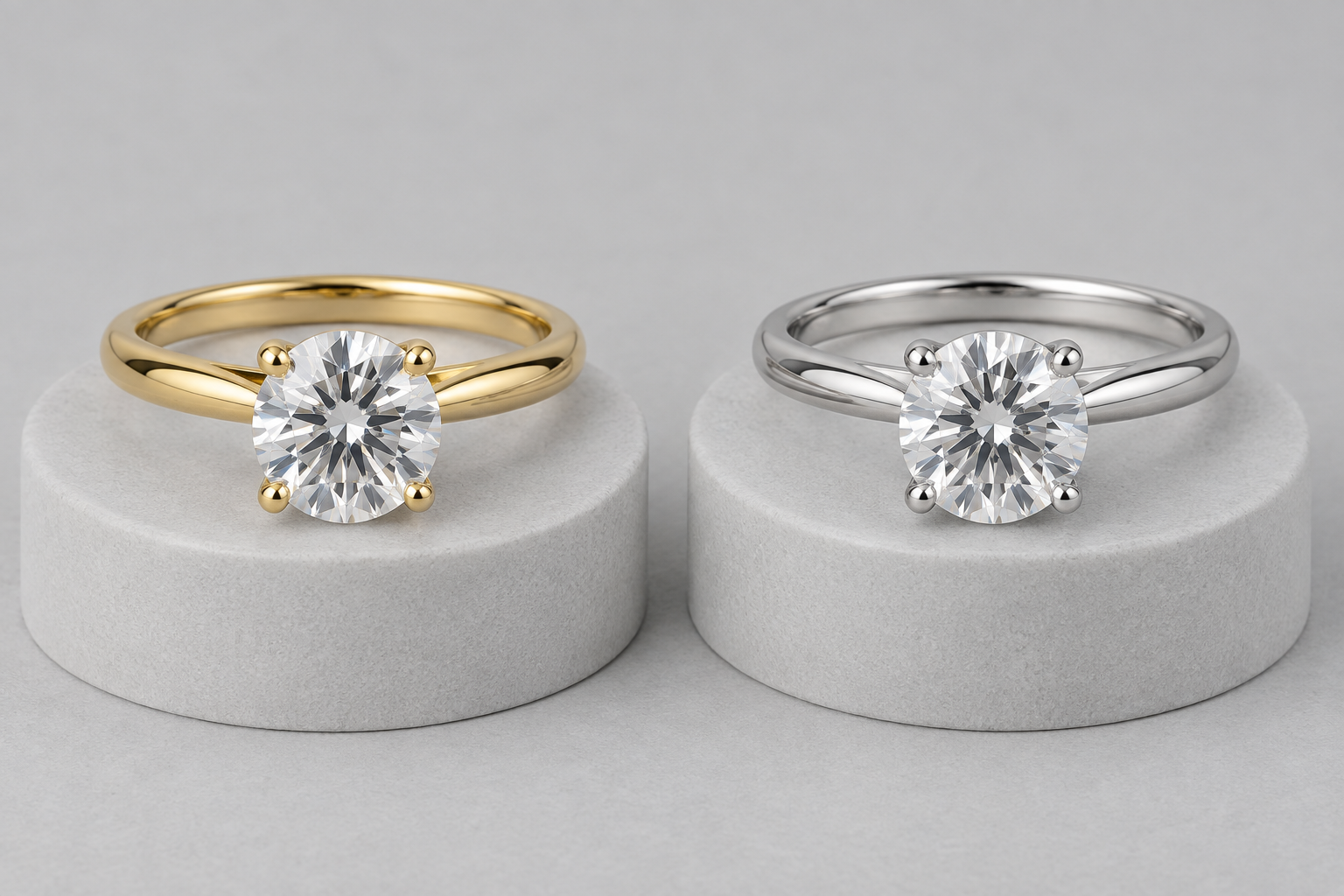
Gold-Plated vs. Rhodium-Plated Sterling Silver: Six Buying Criteria
1. Base-metal and finish disclosure
Use a two-part description: first the verified base metal, then the verified surface finish. “S925 sterling silver with yellow-gold plating” and “S925 sterling silver with a silver-rhodium finish” are clear. “Gold ring” or “white-gold ring” is not an acceptable shortcut for these products. The FTC Jewelry Guides emphasize truthful representation of metallic content, surface applications, durability, and other material attributes.
2. Color and collection fit
Choose by customer and collection logic rather than personal preference. A warm finish can coordinate with yellow-gold-color displays and fall or holiday palettes. A silver-white finish can support a clean bridal, classic, or cool-metal presentation. If a store serves both preferences, use finish filters and separate display groupings so customers can compare intentionally.
3. Care and wear expectations
Both are surface-finished sterling-silver products. Friction, chemicals, storage, climate, and frequency of wear can affect appearance. LEKANI’s two highlighted rings currently advise storing pieces separately in a dry place, avoiding perfume, household chemicals, and abrasive cleaners, and wiping gently with a soft cloth after wear. Retailers should use the exact care instructions for each SKU and avoid lifetime-finish promises.
4. Photography and digital merchandising
White balance and background color can make warm plating look too orange or make silver rhodium appear gray. For each SKU, capture a neutral-background product view, an angled view of the setting, an on-hand scale image when available, and a detail showing the finish at the shank or chain. Do not reuse one finish photo for another finish variant unless the page makes the difference unmistakable.
5. Variant depth and replenishment
Finish is only one inventory dimension. Rings also divide stock by center-stone option and ring size. Review the live variant matrix before ordering, and avoid spreading opening depth evenly across every size and finish. Start with the combinations that fit the store’s customer history, then reorder from actual inquiries and sell-through.
6. Price architecture without false quality tiers
A warm plated finish should not automatically be labeled “better” than a silver-white finish, and a rhodium finish should not automatically be marketed as more durable. Build price ladders from verified construction, stone option, design complexity, finished weight, supplier terms, and the retailer’s own landed-cost calculation. Color preference is not a quality grade.
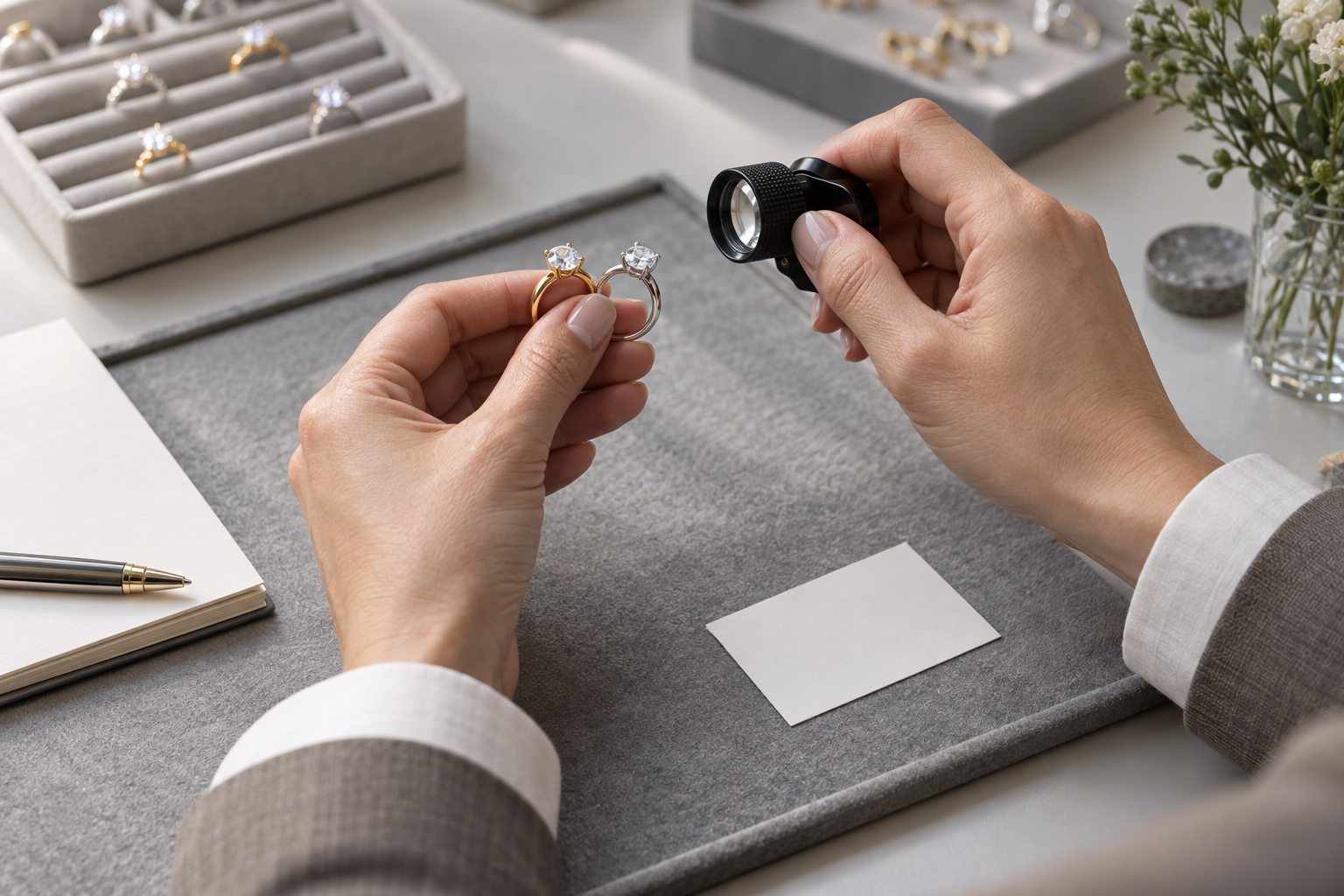
Two Verified LEKANI Styles That Illustrate the Difference
Warm finish: Six-Prong Moissanite Solitaire Ring
The newly listed Six-Prong Moissanite Solitaire Ring in Gold-Plated S925 Silver uses a round white moissanite in an open six-prong setting above a slender band. Its current product record identifies an S925 sterling-silver base, yellow-gold plating, 1 ct and 5 ct center-stone options, and U.S. ring sizes as listed. One unit includes one ring. Exact variant availability should be checked on the live product page before a customer promise or purchase order.
Retail role: a classic warm-metal solitaire story. Photograph the profile and six-prong setting, and label the plated S925 construction clearly wherever the product appears.
Silver-white finish: Round Moissanite Pave-Shoulder Ring
The newly listed Round Moissanite Pave-Shoulder Ring in S925 Sterling Silver pairs a round white moissanite center with stone-set shoulders. Its current record identifies S925 sterling silver, a silver-rhodium finish, 1 ct, 2 ct, and 3 ct center-stone options, and U.S. ring sizes as listed. It is sold as one ring, and live availability varies by option and size.
Retail role: a silver-white, more detailed setting story. Show the shoulder treatment, setting height, and scale rather than relying only on a face-up center-stone image.
For a broader review of stone dimensions, setting construction, ring-size depth, inspection, and engagement-season planning, continue with LEKANI’s Wholesale Moissanite Rings Buying Guide.
Build a Two-Finish Holiday Assortment Without Duplicating SKUs
A compact opening order can test distinct retail jobs instead of buying every design in both colors:
- Warm classic: one yellow-gold-plated S925 solitaire with a straightforward gift or proposal story.
- Silver-white detail: one rhodium-finished S925 style with pavé shoulders or another clearly visible design difference.
- Size plan: depth only in the ring sizes supported by store history, customer requests, or a deliberate test.
- Stone plan: compare live center-stone options and keep the product page clear about the selected variant.
- Reorder rule: replenish by finish, size, stone option, and SKU—not by a general product name.
This approach gives the sales team two understandable stories while reducing near-duplicate inventory. It also supports holiday gift guides organized by color preference, style, or recipient rather than unsupported luxury rankings.
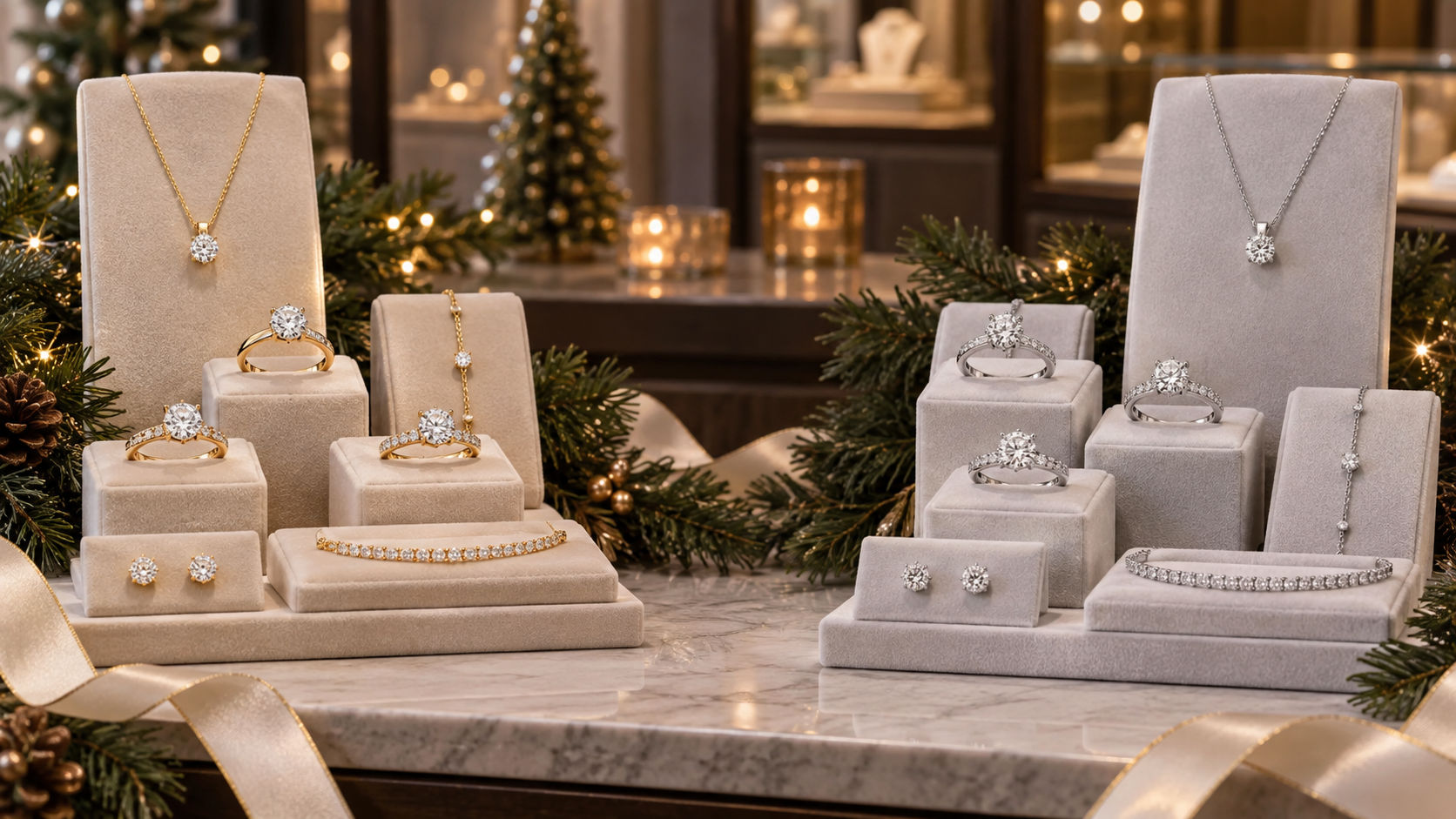
Product-Page Fields Retailers Should Keep Searchable
Search engines, AI answer systems, sales associates, and wholesale buyers all benefit when core facts appear in page text rather than only inside images. For every plated S925 SKU, record:
- Base metal: S925 sterling silver.
- Surface finish: the exact verified finish, such as yellow-gold plated over S925 or silver rhodium.
- Stone identity: moissanite, without calling it diamond.
- Stone option: the exact listed size or carat option for the selected variant.
- Product dimensions: ring size, length, width, or setting dimensions when supplied.
- Unit contents: one ring, one pair of earrings, one bracelet, or whatever the product record confirms.
- Care: SKU-specific instructions without unsupported durability guarantees.
- Availability: live variant status checked before promising fulfillment.
Receiving and Reorder Checklist
- Match product title, SKU, finish, stone option, and size to the purchase record.
- Inspect color consistency under neutral lighting.
- Review prongs, pavé areas, shoulders, shank, interior finish, and polish.
- Confirm that imagery and labels match the physical finish received.
- Keep warm and silver-white variants separate during photography and fulfillment.
- Record customer questions, returns, and finish-specific sell-through.
- Recheck live product availability before adding a style to a campaign or gift guide.
Frequently Asked Questions
Is gold-plated S925 jewelry solid gold?
No. The base metal is S925 sterling silver and the gold color comes from a surface plating. Describe both the base metal and finish. Do not use “solid gold,” “gold filled,” or “vermeil” unless the exact product documentation supports the term.
Is rhodium-finished S925 jewelry white gold?
No. Rhodium-finished S925 jewelry remains sterling silver with a rhodium surface finish. White gold is a gold alloy and must be identified by its verified karat content.
Which lasts longer: gold plating or rhodium plating?
There is no responsible universal answer without the exact specifications and use conditions. Surface preparation, plating process and thickness, contact and friction, chemicals, storage, climate, and frequency of wear can all affect appearance. Compare supplier documentation and use accurate care language instead of lifetime claims.
Can a retailer carry both finishes in one opening order?
Yes. LEKANI’s current wholesale FAQ says eligible styles, finishes, sizes, and categories may be mixed, with a one-piece minimum per SKU. The opening order minimum is US$99 per warehouse before shipping and tax; after the first completed order, reorders have no minimum order value. Verify current terms before ordering.
How should plated S925 jewelry be photographed?
Use controlled neutral lighting and consistent white balance. Include a full product view, an angled construction view, a close-up of the finish and setting, and a scale or wearing image when available. Do not represent one finish with another finish’s photograph.
What should a retailer test first?
Begin with a small number of clearly different retail roles—for example, one warm classic solitaire and one silver-white detailed setting—then use customer inquiries, sales, returns, and reorder activity to decide which finish, size, and stone options deserve depth.
Next Step for Wholesale Buyers
Compare the two verified ring styles above, review the live moissanite ring collection, and confirm the exact finish, stone option, size, and availability before ordering. Read the Wholesale FAQ and create a wholesale account to view current wholesale pricing and build a mixed-SKU test order.
References: U.S. Federal Trade Commission Jewelry Guides and consumer guidance on gold and silver jewelry; GIA guidance on white metals and sterling silver; JCK’s 2026 show and holiday-retail coverage. This article provides general wholesale buying and merchandising information, not legal advice.


